Posted in Creative Nonfiction Essays, Living Life, Uncategorized

Glass Half Empty…..or Half Full?

image

Are you a glass half empty or half full person? I confess. I can often be a glass half-empty person….a bit of a pessimist. Not always. It depends on what we’re talking about. I can also be a crazy glass half-full optimist. This expression is used so often now that it’s often just referred to as the “Optimist/Pessimist saying.”

The glass half-empty saying is an idiom. When you think about it, you realize it is used to illustrate that different people perceive a situation in different ways. Some optimistically. Some not so much. How you perceive a situation is based, to some extent, on your own experiences during your life. Some people have had experiences that have made them more an optimist than a pessimist and vice versa.

The glass half-empty principle really becomes interesting when you think of how attitude affects your health. If you always see the glass half-empty, then you have a pessimistic view of life. Can that possibly be healthy? Of course not! If you are an optimistic person, you wake up every morning and see the day filled with possibilities. You expect positive results from what you do each day. A study done consisting of a group of law students in 2012 found that the law students who were optimistic made more than $30,000 above their pessimistic counterparts. Optimism creates good fortune. If you are a pessimist and expect bad things to happen, it will be a self-fulfilling prophecy.

It’s a tough world out there and you can use the glass half-full/half-empty saying to help yourself out if you are trying to improve your life by…..let’s say……buying a home, getting a job, or something else equally difficult in this world of ours. First, avoid pessimists! They drain your energy and sap your self-confidence. Engage with people like an optimist. Carry yourself well. Don’t slump. Look good. Spiff up your personal hygiene — hair, nails, clothes. Smile and laugh. Laughter really is the best medicine. Think of that half-full glass and feel optimistic and smile. Laughter has all kinds of health benefits such as lowered blood sugar and blood pressure. Plus it makes you look good and feel good. Get some exercise. Take the dog for a walk. Exercise releases all those feel good endorphins.

We live in a world that tends to be a glass half-empty place. Be a glass half-full person  and you will be surprised what you can accomplish. #writing #amwriting #blogging #glass half-full #dailyprompt


Posted in Creative Nonfiction Essays

Map Quest

image

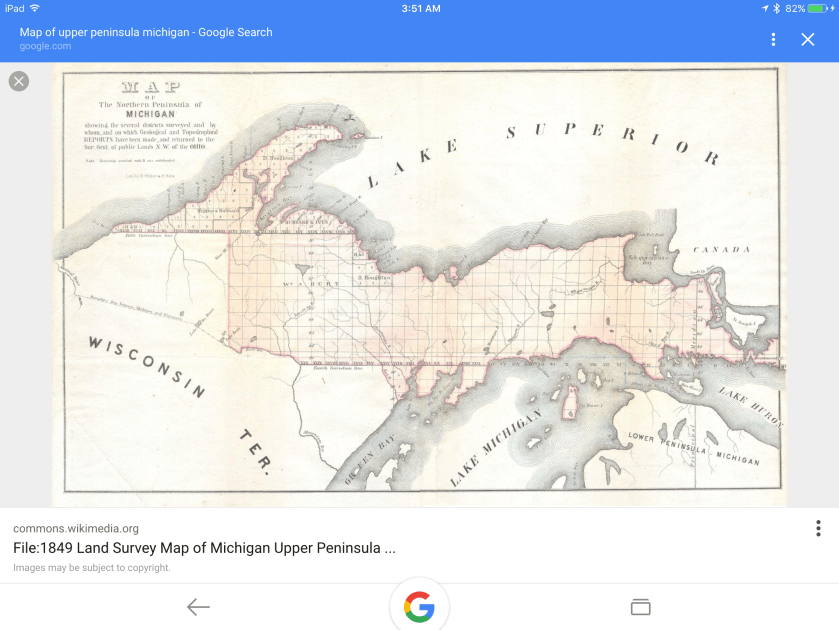
If you want to come see me, follow the map and these directions:

1. From wherever you are, go to Interstate 75 which runs north and south from southern Florida to northern Michigan. Go north on I-75. Be careful. No matter where you are on I-75, the traffic is heavy. It is the most heavily traveled interstate highway in the U.S.

2. Depending on where you get on I-75, you will see lots of beautiful scenery. From the swamps of the Everglades in Florida, through Georgia’s piney forest, to the foothills of the Appalachian Mountains in Tennessee and Kentucky. Next comes the Buckeye State of Ohio where you will find farming and manufacturing and, finally, Michigan, but Lower Michigan.

3. Lower Michigan is the mitten-shaped part of the state. I-75 will take you past Detroit and Flint, where I have relatives, then up through the central part of the state where my aunt and uncle made their home. A couple of more hours of driving and you are at the foot of the Mackinaw Bridge. It’s summer so the big bridge in the sky should be relatively easy to cross. In the winter, that is not always true. Of course, you can always get an escort to drive you across.

4.  When I went to the Upper Peninsula of Michigan for the first time, we took a ferry across the Straits of Mackinaw. The Mackinaw Bridge is the longest suspension bridge between two anchorages (the Lower and Upper Peninsula of Michigan) in the Western Hemisphere and is five miles in length. It carries four lanes of I-75.

5.  Keep going north as you pass St. Ignace on the northern side of the Mackinaw Bridge. Remember that you go north until you run out of I-75 which is at Sault Ste. Marie, MI on Lake Superior. When you get to Sault Ste. Marie, turn west on MI-28, heading toward Marquette, MI at the western end of the Upper Peninsula. You will be treated to a beautiful drive along the southern shoreline of Lake Superior. The lake is wild and the shoreline is rocky. The rocks are the most beautiful you will ever see. Stop and pick up some.

6. Some of the attractions along the southern shore are Pictured Rocks National Seashore, Grand Island, and Munising Waterfalls…..and much more. You can stop or continue on to see me.

7.  You are still on MI-28 but now you are getting close to Marquette, MI. Start watching for an old road on your right which is called Old MI-28. When you see it, turn right onto Old MI-28. You will see a group of log cabins along this road. My cabin is the third  one on the right along the lakeshore. Aren’t the birch logs that it is made out of beautiful? You are in Shelter Bay, MI.

You have found me at this beautiful spot. You’ll know it’s my cabin by the great big rock in Lake Superior right in front of the cabin. See all the cars out back of the cabin? My family is having a party. Come join us. There is just one caveat. You’ve found me, but it’s the six-year old me and the year is around the early 1960’s.

I visited this cabin in Shelter Bay, with my parents, often during my childhood and growing up years. My dad’s family would always rent it and I remember my time there as one  big happy party. My dad’s family believed in having a party and they could throw a good one. All my great aunts and uncles would show up along with most of my dad’s siblings. My mother, who grew up in the Kentucky Bible Belt, was decidedly uncomfortable, but she had to learn to cope.

The cabin front, facing Lake Superior, was glass on three sides with cots around the outside of the room. At six years old, I still remembered a lot. The porcupines that lived under the porch. The fact that there was an outhouse, not a bathroom, took some getting used to since there were black bears roaming at night and the porcupines. In the kitchen, everyone cooked on an awesome wood stove. I can envision my grandfather sitting in a big chair by the fireplace that was used year round.

What I remember most was the love in that cabin when we were all there. There was so much love that I felt enveloped in it. Some days, I wish I could go back to being six years old and in that cabin again. Like today. I’ve lost a dear friend under difficult circumstances. Lake Superior, my family, most of them gone now, and the love in that cabin is calling me. #dailyprompt #writing #amwriting #blogging #everydayinspiration


Posted in Father's Day, Holidays, Uncategorized

Father’s Day in the U.S. And Other Countries

image

My dad has been gone for 33 1/2 years and I miss him as much today as I did when he died. Particularly on Father’s Day, the third Sunday of June in the United States. My dad was a fun, but hard-working parent, never aimless. I miss the twinkle in his eye when he saw me and the spring in his step when he carried me to bed! This poem reminded me of him.

Father’s Day was first celebrated by Sondra Dodd in 1910 in Spokane, Washington. She had lost her mother in childbirth and her father cared for her. She wanted to show her appreciation for him. Sondra’s dad’s birthday was June 5, so Father’s Day unofficially ended up in June. The movement to establish a day to honor father’s grew and in 1924, President Calvin Coolidge became a supporter. He did not declare it an official holiday.

Father’s Day was celebrated in June. In 1966, President Lyndon Johnson declared it an official holiday and designated the third Sunday in June as the official date for Father’s Day. In 1972, President Richard Nixon declared Father’s Day to be a national holiday.

There are some interesting and fun facts about Father’s Day in the U.S.

There are over 70 million fathers in the U.S. And 2 million of them are single. It is the fourth busiest day for sending greeting cards. More than 214,000 men are single fathers.

Other countries also celebrate Father’s Day. Canada celebrates it like the U.S. but unofficially. France celebrates Father’s Day on the third Sunday in June. They used to give their fathers’ Bic lighters but now they substitute other small gifts. Germany celebrates the day on the last day of the Easter holiday.

In Asia, India celebrates Father’s Day much the same way as we do, but Thailand celebrates the day on the birthday of their king and everyone wears yellow. In Australia, Father’s Day is celebrated on the first Sunday of their spring which is September.

Now, I’m going to go and start the dinner I’m preparing tonight in honor of my dad. Happy Father’s Day to all the dad’s out there!


Posted in Music, Uncategorized

Livin’ in the City

image

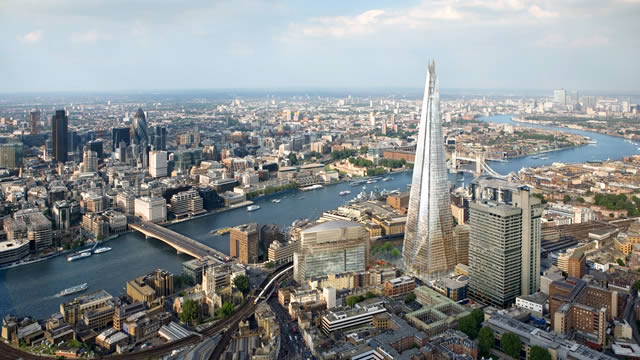
Livin’ in the city! I lived in the city for 25 years and I miss it every day. I love living in my cabin in the woods in the country. When I moved here 18 years ago, I needed to be away from the city. I needed the respite. But, I’ve always missed the city, my city. There is just something about the city, some energy I get from the city, that just doesn’t happen in the country. I can’t put my finger on it, but my head starts buzzing with all kinds of possibilities when I drive into the city, any city.

My favorite big city in the U.S. is probably Chicago, IL. Think of the possibilities in Chicago. All the restaurants you can choose. The museums, the shopping….always important to this girl. There is culture. But, there is my rock and roll fun too. I went to one of the best rock and roll clubs I’ve ever been too in Chicago with an old friend who is, sadly, gone now.

According to a Wall Street Journal study, there is a rather significant health advantage to living in the city compared to rural areas though the study finds that the health advantage is a function of age, income, and education. In other words, poorer people in cities don’t have this health advantage. Rural areas are served by only 10% of the country’s doctors. There is also indications that people in rural areas have a harder time getting health insurance. From this perspective, there is no health advantage to living in rural areas except the cleaner air and, perhaps, healthier food.

The Wall Street Journal study noted that people living in the city have a higher incidence of developing stress-related mental and emotional problems. Considerably more anxiety and mood disorders. Researchers have even discovered that urban dwellers process stress differently than rural dwellers. Their brains are different.

Almost everything you read about living in the city talks about the problems associated with city living. Health problems, homelessness, pollution, housing, and  more. You find very little research about the good aspects of city living. But, on a personal level, I love city living. It kicks me into high gear. It gives me energy and motivation. It fills me with possibilities.

For your enjoyment, here is Joe Walsh singing one of my favorite songs…..In the City. Enjoy!


Posted in Appalachia, Eastern Kentucky, history

Appalachian Folklore: The Jack Tales

image

Storytelling is a tradition in Appalachia. Down through the decades, many Appalachian children and adults have spent nights on the front porch, gathered around an elder, listening to stories that have seldom found a place in written forklore. Most of the stories have been in oral format only. This is true for the Jack tales though historians and some storytellers are making an effort to capture them in writing. Jack tales are seldom told in the same way twice which makes writing them down difficult. Different storytellers tell them in different ways. Even the same storyteller may change the telling of a Jack tale from telling to telling.

We’ve all heard of Jack and the Beanstalk, Jack and the Giant Killer, Jack and Jill, Jack Sprat, Jack Horner. There are many other Jack tales. All are examples of the Jack tales that originally came to America from the British Isles. The first Jack tales can be traced back as far as the fifteenth century in Great Britain. By the next two centuries, the first tellings of the Jack and the Giant Killer story can be found. That’s when the rhyme, “Fi-Fy-Fo-Fum, I smell the blood of an Englishman,” can be found in English literature for the first time, including in Shakespeare’s King Lear. Jack, who was supposedly located in Cornwall, England, trapped the Giant in a pit in order to kill him. Other giants were also present in the tale. By the eighteenth century, the Jack tales were found in the nursery as they had been turned into nursery rhymes.

As the British immigrated to America, along with the Scots and the Irish, each culture brought their own rendition of the Jack tales. The versions of the Jack tales were likely combined to become the Jacks that we know and love today. A book by Richard Chase, published in 1943, is a collection of at least some of the Jack tales. Chase alleged that many of the Jack tales were collected by a group of families in North Carolina and came into Southern Appalachia from that area. Chase did acknowledge that new Jack tales were surfacing in other parts of Appalachia, specifically in Virginia and Kentucky. In Harlan County, KY, Mrs. Sally Middleton of Martin’s Fork, knew versions of two of the Jack tales of North Carolina that she carried on. In all of the Jack tales, Jack is thrown into difficult situations. In the Appalachian versions, the themes reflect the problems of the area such as poverty and farming and the harsh conditions of life.

Jack is probably the first legendary hero in American literature. Counce Harmon was one member of the families in North Carolina that passed the Jack tales down for most of 200 years before they were ever written down. Here is a telling of a Jack tale for your enjoyment by a descendent of Counce Harmon, one of the original tellers of the Jack tales in America:


https://youtu.be/t3S5dry-IKk


Chase, Richard. (2015) The Jack Tales. HMH Books for Young Readers.


Posted in Home, Uncategorized

Time to Rebuild, Part 2

  • image

When I left the story of my house flood in Time to Rebuild, Part 1, I was standing in my kitchen, in shock at the devastation a broken water pipe had caused while I had been gone for 3.5 weeks. I later found out, when I got my water bill, that 178,000 gallons of water had spilled from that water pipe during my absence. My homeowner’s insurance company said that was the largest amount of water they had ever dealt with on an insurance claim. It was a wonder my house wasn’t washed off its foundation.

When I left you at the end of the first part of the story, the first call I made was to the  homeowner’s insurance company. They sent an adjuster right out. She basically told us that everything was ruined. Even items that had not gotten wet and sat in high humidity for 3.5. weeks. They had to be replaced if possible. The first question, however, was where were we going to live. Clearly, the house had to be totally renovated. We decided to live in our RV, parked by the house. We had a dog and a cat, so living in a hotel was out of the question.

Next question was who to hire to renovate my house. The insurance company knew just the company. They specialized in flooding problems like mine. Within one or two days, they were here, on the job.

I am a private person. Not very open about my personal and private possessions. It was very difficult to watch the work crew unload every piece of furniture in my house, remove everything in them, box it up, and haul it to their warehouse. It took weeks to get everything emptied and stored. Then, the furniture had to be moved to their warehouse. Finally, it was time to start work.

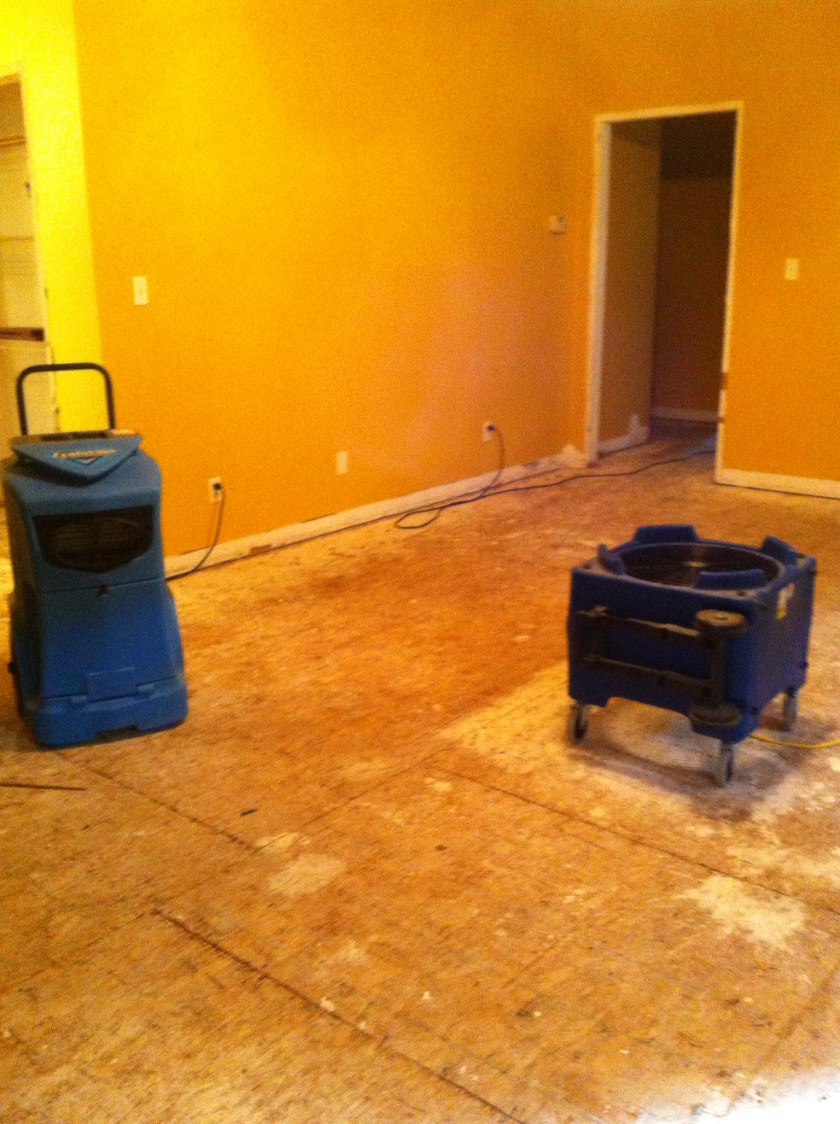
The first thing the crew had to do was to dry out the house. It had gotten so wet and had suffered so much high humidity that it took weeks. They used big dehumidifiers and that is the picture you see above. Three weeks passed as they made sure everything was dry and tried to assess the damage. As you can see in the photo, the house was stripped down to its bare bones. The flooring and carpet was pulled up. Appliances were trashed. Furniture was either trashed or warehoused. Even the woodwork had to be taken off the door facings and, finally, the drywall was removed and new drywall put in its place. It was a shocking experience.

After the house was dried out, the renovation crew went to work. They were good and professional. They knew exactly what to do with a house that had been flooded. Slowly, I saw my house come back together. We had to be part of that. The kitchen had been totally destroyed and had to have new appliances and new cabinetry. The entire house had to have new floors or carpet. The water had poured through the heating/cooling system. It had to be replaced. I could go on and on about what had to be replaced but you get the picture. Everything.

The renovation crew wanted to make sure everything was clean and dry. The water had all run from the house into the crawl space. They had to dry it out too. They used a technique called soda blasting to get rid of any possible problems there.

It took four months. Living in a RV with a cat and dog for four months wasn’t fun but at least we had someplace to live. We even had to slowly start replacing our clothes, which were ruined due to high humidity. I started trying to save family pictures.

As the renovation crew started to finish, we had to go to their warehouse and let them help us determine what could be saved and what could not regarding our furniture and personal possessions. That was difficult. Water is very damaging to anything it touches for any period of time. We lost a lot but we were able to save some too. We were able to replace the big things – appliances, for example. The wood furniture – some of it we could save but all of it had to be refinished as the humidity caused the finish to slide right off of it. Most upholstered furniture was ruined.

Finally, our move in date came. The renovation company hauled everything back. Then, we had the job of sorting through our possessions, assessing damage, tossing what couldn’t be saved. But, we could live in our house once again.

That was a year ago. It’s now the summer of 2016 and this happened in the summer of 2015. We moved back in during the latter part of September 2015. Our house is not the same. For awhile, it definitely didn’t feel like home to me. I’m getting more used to it now. It really is an entirely new house on the inside.

Gentle Readers, please allow me to give you one piece of advice that I wish someone had given me. If you leave your home for very long, turn your water off at the road. At  your water meter. That is the only safe thing to do and, if a water line would break inside your home, it will keep a flood from happening. You don’t want what happened to me to happen to you.

*Photo courtesy of Rosemary Carlson copyright 2016

Posted in Music, Uncategorized

Our 2016 Concert Tour

image

*Photo courtesy of gorupdebesanez Creative Commons 2014

They say big, loud, crowded rock concerts are for college students and the young, don’t they? I’m not sure who “they” are, but they’re wrong. My friends and I grew up in the age of rock and roll. The 1970s. Listening to classic rock is our natural state. We got to see some of the rock and roll groups that were popular in our day back then, but we were busy with college and young marriages and jobs and just life and we didn’t get to see them all. One of my friends decided to rectify that situation and invited me to join her. I couldn’t say YES fast enough!

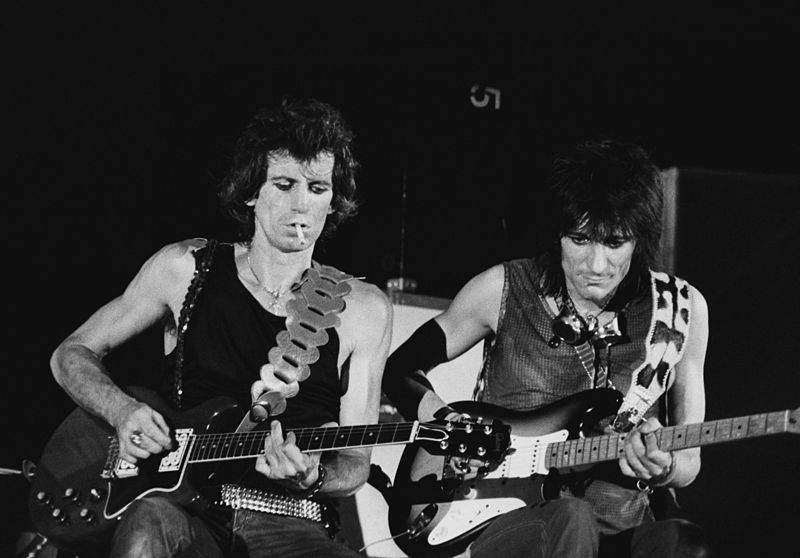
Rock and roll is our passion. The sound track of our lives. Just about every rock and roll song and every rock and roll band reminds us of something that happened in our lives….or someone. I love this music as much today as I did when I was 20….no, maybe I love it more. My favorite rock and roll group is the Rolling Stones and I don’t care how old they are, they still play my kind of music. My friend and I and our husbands saw the Rolling Stones play in Cleveland, OH many years ago. We’ve never forgotten that concert. If the Rolling Stones tour again and play anywhere close to where we live, we’ll be there. On the front row if we can get tickets.

While we’re waiting on the Stones, we’re going to see rock and roll bands we’ve wanted to see for years. We have tickets, some with other friends and family joining us, for four more concerts in 2016 and who knows, we may add more. We’re going to enjoy every single minute of listening to the soundtrack of our lives. #RollingStones #classicrock #amwriting #writing #blogging

Posted in Finance, Uncategorized

Social Responsibility in Banking

image

2008 Financial Collapse in Banking

Since the near collapse of the U.S. financial institutions at the end of 2008, the social responsibility of these and other institutions have been front and center in the American consciousness. It became apparent that the big banks and other financial institutions were all about profit and shareholder’s wealth in the short-term and not about their customers at all. It also didn’t seem that these corporations cared about their long-term profits or wealth of their shareholders because they allowed greed to take them so close to financial collapse. This attitude flies in the face of every principle of financial theory under which publicly traded institutions should operate.

The financial crisis in the U.S. really started back in 1999 when the Glass-Steagall Act was repealed. This legislation protected customers and shareholders alike because it prohibited banks of all sizes from engaging in both investment and commercial banking. Banks either had to be an investment bank which sold securities to the public or they had to be a retail bank that accepted deposit accounts and made loans. They could not do both. When Glass-Steagall was repealed in 1999, the scenario that followed was an almost exact replica of what happened in the 1920’s and the resulting stock market crash. Back then, banks were allowed to both accept deposits and make loans and issue securities. A bubble in the stock market resulted due to fraudulent activity and the stock market crashed. In 1933, Glass-Steagall was passed and protected shareholders and consumers alike until 1999. Then, the cycle began all over again. By 2007, banks were facing a crisis of liquidity and by the end of 2008, we really don’t realize how close our banking system in the U.S. was close to complete collapse. It would have collapsed had the Federal Government and the Federal Reserve not bailed them out.

By 2008, the banks had been mingling the investment and deposit functions for nine long years. They had been issuing securities and making loans. We know at least part of the story and there are many causes of the 2008 financial collapse. It was, indeed, a worldwide collapse. Consumers of financial products, such as mortgages, were not blameless. Even though corporations like the  big banks and non-banking corporations that failed, like Lehmann Brothers and AIG, are responsible for protecting their shareholders and consumers, those stakeholders pushed these corporations hard for these financial products. In the giant real estate bubble that resulted from the banking practices during that time, it was hard to say no.

Banks and other financial institutions should have said no. They should have stood up to their ethical responsibility to their shareholders and consumers, as well as to their employees. They are the experts. They are the ones with the full financial information, not the shareholders or consumers. They should have used their expertise to stop the fraudulent and unwise banking practices that were the “soup of the day” at that time. But, they did not. They paid the price and so did the consumer.

Banks used their ability to offer investment banking and loans to develop rather exotic financial products such as the subprime loan. This was a mortgage loan made to risky borrowers with poor credit histories that struggled to pay off these mortgages and many of them defaulted. They were then turned into pools of mortgages, called mortgage-backed securities, and were gathered into securities by the big banks called collateralized debt obligations, given high ratings by the credit ratings agencies, and sold to investors. Unfortunately, investors found out later they really weren’t worth anything. Interest rates were low and banks kept searching for riskier and riskier products in which to invest.

Mortgage-backed securities began to fail and collateralized debt obligations proved to be worthless. The banks’ capital positions began to erode. Banks have to always have a certain percentage of capital on hand to be sure they have adequate capital to meet the demand for customer withdrawals and loans. Bank regulators, charged with insuring that banks have adequate capital, seemed asleep at the wheel. Even as this was happening and banks were operating with a razor-thin capital position, consumers were demanding more and more low-interest mortgages.

In late 2008, it all came tumbling down. Banks and consumers alike realized that prosperity could not be built on bigger and bigger piles of debt. Investors suffered because the exotic securities they had purchased were worthless. The housing bubble burst and the price of homes dived steeply. It was a buyer’s market and seller’s just sat on their houses. Capital ratios for banks were so thin as to be non-existent and they had to be bailed out.

Had the financial institutions just remembered that one of the tenets of financial theory is not only maximization of shareholder wealth  but also social responsibility, none of this would have happened.

Not only do the managers and directors of a publicly-held business firm have a responsibility to maximize the stock price of that firm, they have a responsibility to maximize the stock price in a socially responsible manner. If a bank were a steel mill, they wouldn’t spill all their pollution into the air  because, in the long run, this would lower their stock price as investors and consumers alike would eventually feel the effects of that pollution. In banking, if the managers engage in risky behavior with the money of the consumers and stockholders and the jobs of their employees, they may reap the benefits for a short time, but in the long run, that bank runs the risk of financial collapse. Just  what happened in the 1920’s and again in 2008. Social responsibility is the only reasonable strategy for business firms if they want to survive in the long-term.

*Photo by waxesstatic @ flickr.com 2008

Freeman, R. Edward, ―A Stakeholder Theory of the Modern Corporation,‖ in Ethical Theory and Business, 5th and 6th edition, Tom L. Beauchamp and Norman E. Bowie, ed., 1997, 2001 Prentice Hall Inc.

Palazzo, Guido, ―Corporate Social Responsibility, Democracy, and the Politicization of the Corporation,‖ Academy of Management Review, 33 (2008), 773-75.


Posted in Home, Uncategorized

Time to Rebuild

 image

Time to Rebuild, Part I

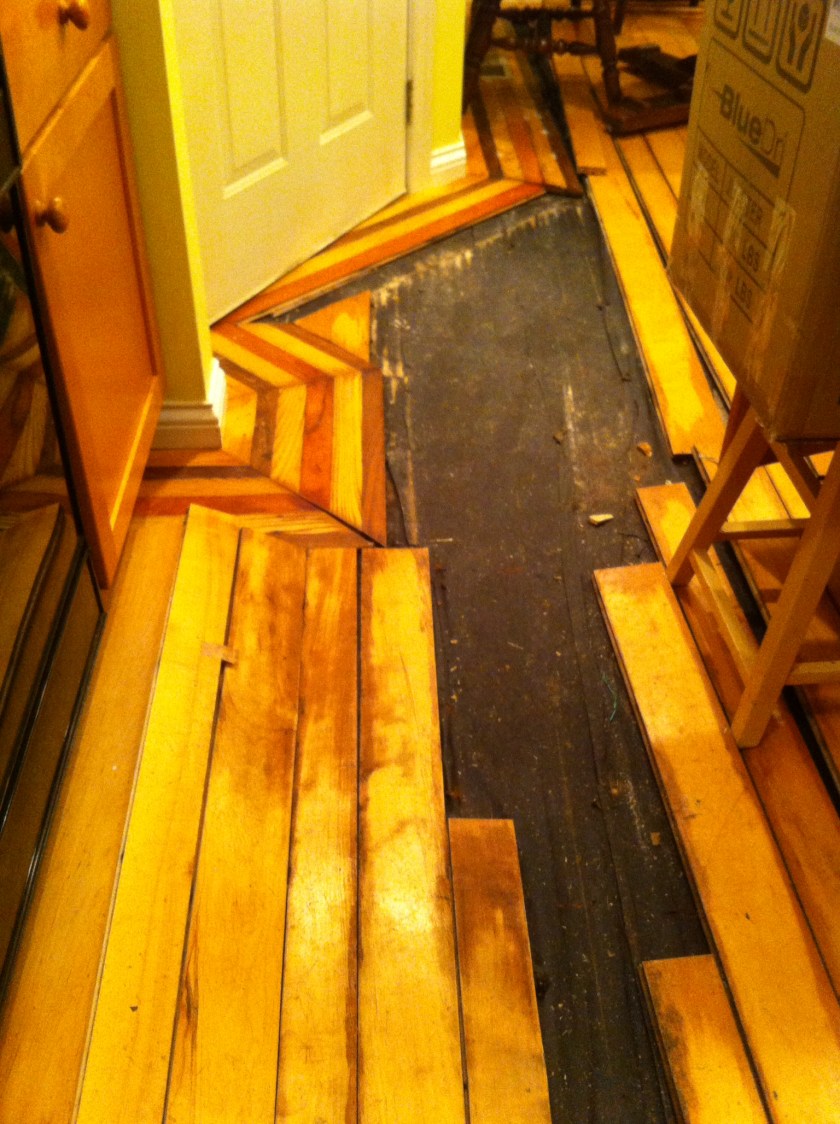
When I walked into my house, after shoving in the door, I knew we would have to rebuild. The entire inside of the house. It was destroyed. It was such a shock that I was shaking and felt I had to sit down, but there was nowhere to sit. The furniture was knocked over and wet. I couldn’t even sit on the floor. It was wet but not only that. The hardwood was raised up. The water had caused it to move and stack itself up in piles. It was the most unbelievable thing I had ever seen. The power of water. The power of a flood. The necessity to rebuild the entire interior of a house due to a flood.

This is what happened to me and my family last summer, the summer of 2015. We had been on vacation. Traveling around New England in our RV. We were planning to be gone for six weeks and had gotten as far as Cape Cod. We were planning to go as far as northern Maine before heading south again. We had so enjoyed the southern coast of Connecticut on Long Island Sound. We had actually enjoyed the entire state of Connecticut. The beautiful Cape Cod houses in their traditional New England colors. The campus of Yale. The mansions along the Rhode Island coast. The Mystic harbor and the old ships. On the way north, we had seen so much in Maryland and Pennsylvania — become familiar with those two states beautiful states. America is really a wonderful, gorgeous place.

When we got the call about the flood in our home, we were, of all places, on a large boat off the shore of Plymouth, Massachusetts on a whale-watching tour. My cell phone rang. I wish now I had not answered it but finished the tour instead. But answer it I did and heard what no one on vacation ever wants to hear. My neighbor said, “Rosemary, I have bad news.”

A pipe had burst under a sink in my kitchen. My neighbor had noticed water running out of my house — a sure sign of something being wrong. He had a key and walked in to check. He didn’t really walk in. He shoved his way in as he couldn’t open the door because the floor being pushed up blocked it. Water was everywhere. Even standing in the drawers of the cabinetry in the kitchen. He and another neighbor looked through the house. The water had knocked over furniture, ruined the floors, and they actually couldn’t tell all the damage that had been wrought. They  just knew it was bad. Very bad. So, my neighbor made that phone call.

The eighteen hour trip home in an RV over the Allegheny Mountains was the longest trip of my life. We hardly talked. We hardly stopped — only for gas and to eat. Neither of us could really eat. We just snacked. When we got home and pulled the RV into the driveway, we just sat there for a few minutes. We knew there wasn’t much use to hurry. We didn’t know when the water pipe had burst, but we got the call about the flood 3.5 weeks into our trip. Later, much later, the insurance adjuster told us that it probably burst quite soon after we left based on our water bill and the damage done to our home.

So we took a deep breath, got out of the RV, and started toward the house. I had the house built myself, at that time it had been 17 years. I had put a lot of blood, sweat, and tears into my home. I couldn’t imagine that the inside was destroyed. We opened the door. #flooding #amwriting #writing #blogging

Stay turned for Time to Rebuild, Part 2.

Posted in Uncategorized, Women's Issues

Friendship

image

When we are young adults, most of us have many friends. We still have our friends from high school. We make friends in college. We have embarked on our careers and have work friends. We have friends from other walks of life that we have made along the way. As we go along through our lives, not all of those friends stay with us. We lose some along the way. Some become involved in their families and with their children and don’t feel they have time for friendships. Others are trying to establish demanding careers and they are lucky to get home at night in time to fall into bed, get a few hours sleep, and do it all over the next day. Some friends develop interests that are different than ours and friendships die a natural death. Others move away and the geographic distance makes maintaining friendship challenging.

As our friends change and step into their adult lives, we change too.

If we are emotionally healthy, we develop an understanding of why friends come and go and we don’t end up with any resentment toward these individuals who were our friends. As we get older, our friends tend to fall into several categories:

1. Casual Friends: These are the friends you might go to a movie with, or shopping, or even lunch. Casual friends are usually for pure social interaction. But, you aren’t going to tell them your deepest and darkest thoughts and secrets.

2. Business Friends: These are your work friends. They are people you see daily, collaborate with on projects, and may have a little social interaction with like daily lunches. It is easy to let them become at least casual friends, but these friends can become toxic due to issues like professional jealousy.

3. Intimate Friends: Don’t think sexual here. That is not what I mean by intimate friends. Intimate friends are your best friends. I am of the opinion that you have only a handful of real intimate friends in your life, though your perception may be that you have more than this. I think that is a dangerous perception. Intimate friends are those with whom you share your hopes and dreams and your deepest thoughts and feelings. You trust these friends implicitly.

4. Toxic Friends: These friends are those you make, perhaps at work, that latch onto you without knowing you well but who want to know all your deepest and darkest secrets. They may also be casual friends who are not emotionally healthy and become obsessed. The sooner you can get out of a toxic relationship, the better.

The whole discussion of friendship begs the question: Why do we need friends? Why can’t our spouse or significant other, serve as the only friend we need? The answer, I think, is simple. People need people. Not just our spouse or significant other. Women need their girlfriends. We find being around our girlfriends soothing and satisfying. We can talk to them and get things off our chests. We can listen and help them do the same. We feel needed.

In order to work, friendship has to feel right. One person can’t be a better friend than the other. There can’t be any passive-aggressive behavior or hidden agendas on either side. There has to be openness and honesty. There has to be mutual sharing and respect. Both people in a friendship have to be able to talk to the other. If we have that with our girlfriends, we have real friends. #amwriting #writing #blogging #Bestfriends!