
Posted in Creative Nonfiction Essays, Uncategorized, Women's Issues

The Glass Ceiling

image

There are women out there right now reading this blog post for one reason — the title. The glass ceiling. Women and members of minorities work hard all their lives and often can never reach their potential in their chosen profession. Why? An invisible barrier that is unofficially acknowledged in business that especially affects women and minorities but can affect men too. That barrier is called the glass ceiling, a term coined in the 1980’s which represents a barrier to a forbidden level of achievement in the business world, usually upper management.

The glass ceiling is actually an unfair system of prejudices through which employees can see the next level of advancement above their current professional positions but can’t attain those positions because of gender, age, ethnicity, or political and religious affiliation. The media focuses mostly on the inability of women to break through the glass ceiling, but minorities have just as many problems as do women and so do older employees and those of political or religious affiliations that do not set well with upper management. These employees who are staring straight up at the glass ceiling are just as qualified and deserving as other employees who are not hampered by the glass ceiling.

Hillary Clinton, when she won the Democratic Presidential nomination, shattered the highest and hardest glass ceiling in the world. That did not solve the problems for all the women in the world who will still be banging their heads on that glass. There are a plethora of metaphors that are offshoots of the glass ceiling metaphor. For example, young black women claim that there is no glass ceiling for them. They can’t even see through that ceiling and they call it the concrete ceiling! Working mothers call it the “maternal wall.” Asian employees refer to it as the “bamboo ceiling.” There are even more associated metaphors.

Lest the white males who are reading this post feel left out, they are not. There has been more than one case of a man choosing a profession usually reserved for a woman or a member of a minority group who has run up against the glass ceiling. There is a case study of a man who entered the field of sales and applied for a job selling beauty products. He encountered substantial resistance from women in the field. The fields of nursing and public relations are other examples. Those are traditionally women-dominated fields. Men entering those fields often face increased scrutiny, stereotyping, and they bump their heads on the glass ceiling. It forces men to face what women have been encountering in forbidden career choices for years.  When men are affected in this way, it is called the reverse glass ceiling.

Most business analysts believe the glass ceiling has been cracked but not broken. Women still have a hard time climbing to the top. I experienced this myself and you can read about my struggle in my own career in Women and Autonomy: Self-Determination. Baby boomers who have retired and are re-entering the workplace because, perhaps, their retirement savings is not enough to sustain them face age discrimination. Black Americans, Asian Americans, Native Americans – they face the same struggles women face in climbing to the top in the management of businesses. Employees who loudly express political views and employees who make their religious affiliations known may also have problems climbing to the top.

Some in the media and the business world like to claim that the glass ceiling has been broken because of women like Hillary Clinton and Carly Fiorina, who was head of Hewlett-Packard. Fiorina proclaimed the days of the glass ceiling to be over. Fiorina is wrong. Jone Johnson Lewis, in her article Glass Ceiling for Women, cites a Reuters study, conducted in 2008, that says 95% of American workers believe that strides women have made in the job market have improved dramatically, but 86% say that the glass ceiling has been cracked but not broken. There are only women in 14% of the major CEO jobs in the U.S. There are five Black Americans who are CEO’s and Asian Americans are less than two percent of CEO’s of Fortune 500 companies.

There is some hope for the future. Another blogger has found that companies with diversity goals pay their female employers a premium salary in order to draw them in. Check out her blog post. Another blogger encourages women to be their own advocate in her blog post. Yet another blogger discusses how to break the glass ceiling.

The glass ceiling may be an old concept but the U.S. still has a long way to go in order to fix the problem and break the glass ceiling and the “good ole boy” mindset that causes it. #amwriting #writing #blogging #womensissues



Posted in Appalachia, Creative Nonfiction Essays, education, Higher Education, Uncategorized, Women's Issues

Women and Autonomy: Self-Determination

image

One of my passions is writing about women’s issues. Another one of my passions is thinking about the concept of women and autonomy. Why? Back in the 1970s and 1980s, I decided I wanted a professional career. Not only did I want a professional career, but I wanted a career in a male-dominated field. I wanted to get my doctorate in Business Administration and teach on a university level in a business school, specifically in finance.

During those years, there were very few women in the field of finance. Sorry, guys, but back then, that meant I was fighting an uphill battle. To be fair, I think the men of 2016 are far more accepting of women in previously dominated male professions than some of the men were in 1979, when I embarked on studying for my career.

If you look in the dictionary, you will find that the word “autonomy” has several different meanings that actually all mean the same thing. It is defined as “the freedom to determine one’s own actions” and it does not say one thing that is gender-specific. It isn’t just specific to men…..or women.

When I made the decision to study for and embark on my career, I didn’t feel the need to ask anyone, including my husband, if that was an acceptable decision. I felt like, as an individual human being, that I had the autonomy to make this decision myself. I did. It was my right.

I studied for and obtained my Master’s degree (Master of Business Administration or MBA) and then, I studied for my Doctor of Business Administration or DBA. It wasn’t easy. The coursework was hard. Writing the dissertation was hard. Not only did I work the entire time I was going to school, but I was also married and taking care of my mother. At first, I taught at the school from which I got my doctorate. Later, when I was working on my dissertation, I taught at a school 75 miles away and commuted to work. I always laughed and told my friends that my dissertation was written in the middle of the night because that is the only time when I had the time and quiet to do it.

I had a lot of friends who were also studying for their doctorates. Most of the other students in the program were men. There was only one other woman in my field of finance. We had friends, however, across disciplines — in marketing, management, etc. All the women had a similar life and similar schedule to mine. The men were a different story. Either they were single and could concentrate totally on their studies or they were with a supportive partner who carried the load while they studied. Not so with the women in the program. We had to continue on with our traditional roles as women. We saw this as unfair.

Back in those days, others saw it as fair. After all, we made the decision to seek out a non-traditional role for ourselves. It felt like punishment. Even though we had taken back our autonomy as human beings to seek out our careers, we were being punished for not pursuing our traditional roles as women.

The discrimination continued when we took our newly-minted degrees and started applying for jobs. Of course, the discrimination was unspoken and subtle because laws had already been passed before the 1980s prohibiting such discrimination. The women I knew in finance at my school and other schools were seen as odd to have pursued a degree in an all-male field. Lucky for us, universities needed us at that time. The concept of diversity was becoming important. Universities were being encouraged to have a more diverse faculty and hiring a woman for their finance department fit the bill. We all got jobs.

I could keep talking about this endlessly. About how women in male-dominated fields in universities have to work twice as hard for 3/4 of the pay. About how it is extra hard for us to get promotion and tenure. About how our portfolios for promotion and tenure have to be superior to any male colleagues’ portfolio. About how our salary increases never match those of our male colleagues. About how, by the time  I retired, I still didn’t make as much money as male colleagues who had the exact same credentials as I did. About how the schedules I taught, semester after semester, were more difficult than any male colleague I had.

It all finally burned me out. I was tired of fighting. It was a fight. Right up until the end. When I reached the point where I could retire with most of my pension and my health insurance, I did just that. Retired.

I’ve never looked back. I’ve never been sorry I retired. I’ve never tried to get another teaching job even though I am more than qualified. I decided, 27 years before the time I retired, to reach out, take back my autonomy, and have a professional career. It was the most difficult thing I ever did……and, despite the hardships, the most rewarding. I loved teaching. I taught mostly Appalachian students. I loved seeing their eyes light up when they “got” a concept I was teaching. I miss those students. I miss teaching them.

I don’t miss the discrimination and the politics of academia. I don’t miss the service on unnecessary committees. I also loved to do the research that is required of college professors, but there is not enough time given to professors due to such heavy teaching loads to do good research. If I am going to do research in my field of finance, it is going to be good research or I’m not going to do it.

My point in writing this post is to encourage women to take back their autonomy. If you have a passion to do something — anything — do it! You won’t be a fulfilled person if you don’t. If you aren’t fulfilled, you won’t be any good to your family or your community. I urge you, as strong women, to think about what you want to do with your life, get the education you need to do it, and then go and do it. You will be a better, more fulfilled person for it. #amwriting #writing #blogging #womensissues


Posted in Creative Nonfiction Essays, environment, Uncategorized

The Solace of Water

Take a course in good water and air; and in the eternal youth of Nature you may renew your own. Go quietly, alone; no harm will befall you.

— John Muir

image

There is nothing that soothes me like the sound of water. A babbling brook, crashing ocean waves, a trickling stream, waves sloshing against the sand at low tide, the rain on the roof. Those water-related sounds of nature. I think they are built into our DNA. They were there in the beginning .They still soothe me like nothing else.

There are many scientific studies that have researched the effect of water on our brains. Some scientists believe that our brains are hardwired to react positively to being around water, that it calms us and even makes us more creative, and puts us in a mild meditative state. One scientist, Walter Nichols, wrote a book entitled, “The Blue Mind,” which discussed how being around water may even be able to heal what is broken in our brains and increase our happiness and satisfaction with life. He says that water gives our brains some downtime, a rest, which most of us need.

When we hear water or are around water, our “blue” mind takes over and puts us in a state of “we” versus “me.” We can stand at the edge of a large lake or look across the ocean and get a sense of vastness and that there is something larger than ourselves. That helps us put life into perspective.

There are physical health benefits from water as well. The more seafood we eat, the better off we are. Most seafood is full of omega-3’s which increase brain growth. The more we eat, the bigger our brains get. Scientists have also discovered that the more fish you eat, the happier you are.

Then there is our body composition. The human body is about 60% water. The brain and heart are around 73% water and the lungs are 83% water. We, as human beings, feel comfortable being around water. A normal sized male needs a little more than a gallon per day of water to survive. A normal sized female needs about one-half gallon. Water has vital functions in our body. It regulates our temperature. It helps metabolize our food in order to move the nutrients into our cells. It lubricants our joints. It flushes out toxins from our bodies. It helps produce saliva. And much more.

No wonder we like to be around water and that water soothes us! It’s part of us.

I crave being near the ocean and, unfortunately, I live in a land-locked state. I’ve been fortunate to be able to travel and spend considerable amounts of time near the ocean. The only ocean I haven’t seen is the Indian Ocean. The wildest ocean I’ve ever experienced is the part of the North Atlantic called the North Sea. The calmest ocean is part of the Atlantic as well – the Gulf of Mexico. No matter which ocean  I’ve been to, those swooshing sounds of the waves relax my brain and body and let me leave myself for just a little while. That’s all I need. #blogging #writing #amwriting #environment #dailyprompt


Posted in Creative Nonfiction Essays, Uncategorized

Clutter and Stuff

image

Clutter. You know. The stuff you have lying around that you think you might need. That you’re sure you will need……some time, some day. Won’t you? What exactly is clutter? Clutter can be defined as anything we don’t need, want, use or anything that takes up space we need, or our time, our energy, or that destroys our serenity. Do you know where I got that definition? From an organization called Clutterers Anonymous! Yes, there is such an organization. I couldn’t believe it either.

I hate clutter and have been systematically going through my life trying to eliminate clutter. Clutter is, of course, items like clothes you can’t wear anymore, gifts you have received and can’t use, things you have bought and don’t like, books and papers you think you might need but don’t, and unnecessary items stuffed in storage bins and facilities. But, that isn’t all clutter is. It is also unfulfilling relationships, activities we don’t enjoy, and other psychological “junk” that we hold on to because we always have. Our minds can become cluttered just like our surroundings. Clutter seems to multiply of its own accord.

Where did this clutter problem start for so many of us? Many say it comes from fear. Instead of buying one of something, we buy two. We think if we need one, we might need two because that one might wear out, break, become unusable. Maybe we were taught in our childhood to fix things that break instead of throwing them away or to save things we buy because someone might need them. Those broken things and possible gifts pile up. If our clutter problem is bad enough, we feel hopeless. We feel we can never get rid of all the clutter. We have forgotten how to organize. Finally, clutter spills out of our drawers and our closets. It becomes embarrassing and overwhelming. Our hopelessness and helplessness over the clutter becomes worse. Clutterers realize they have a problem with their excess possessions.

Not only have I grown to hate clutter in my own life, I am growing to dislike “stuff.” The trappings of life that we feel we have to have in order to live. What “stuff” is differs for all of us though I think it may have similarities within social classes. We, in the U.S., don’t freely admit that we have a social class structure but we do. In Great Britain, they have always had a relatively well-defined social class system, more so in the past than now, but it still exists. They admit it.

The U.S. middle class, at least in my age group, still wants a nice home. Nothing wrong with that. It is the “stuff” that goes into those nice homes that gets out of hand. I’m as guilty of this “stuff” issue as anyone reading this blog post. Most of us want the good furniture, reasonably nice art on the walls, the latest appliances, the most up-to-date everything, as well as the accessories to pull it all together and make it into our idea of home. Outside of our homes, there are two or three cars, maybe a boat or RV. Nice lawns and landscaping. Individually, we want clothes, shoes, handbags, and jewelry for every occasion. I’m particularly guilty of this clothes issue! Everyone is different regarding how much stuff they like and can live with.

Last year, about this time, my house flooded and I lost a great deal of what I had. My stuff. See my Time to Rebuild blog post. It was devastating. I was most devastated by the loss of the interior of my house but the loss of my stuff was almost as bad. Until I started to move back into my house and started going through all the stuff. I realized how much of it I really did not want or need. How much was unnecessary to my life as it was in the present. How much was just old stuff stored in closets in boxes and was meaningless at this point in my life. So I started sorting. Soon, I stopped sorting and started pitching and throwing. It felt liberating. We moved much less back in than we moved out.

Now, I’m careful what I bring back into my home. I’ve found, once again, that I enjoy people more than stuff. I’ve renewed old friendships, old relationships, and those people are so much more valuable to me and enjoyable than “stuff.” My possessions were not giving me joy. The people in my life do, indeed, give me joy. I’m as careful about new relationships as I am about new stuff. New relationships have to be really worth it to be brought into my life. Otherwise, they are just so much stuff.

Our society has become so fractured and many of us have become so fearful that we surround ourselves with stuff instead of people. A problem we need to try to fix if we are to regain our American optimism and happiness.


*Image by Jonathan Billinger at SO3951

Posted in Creative Nonfiction Essays, Living Life, Uncategorized

Glass Half Empty…..or Half Full?

image

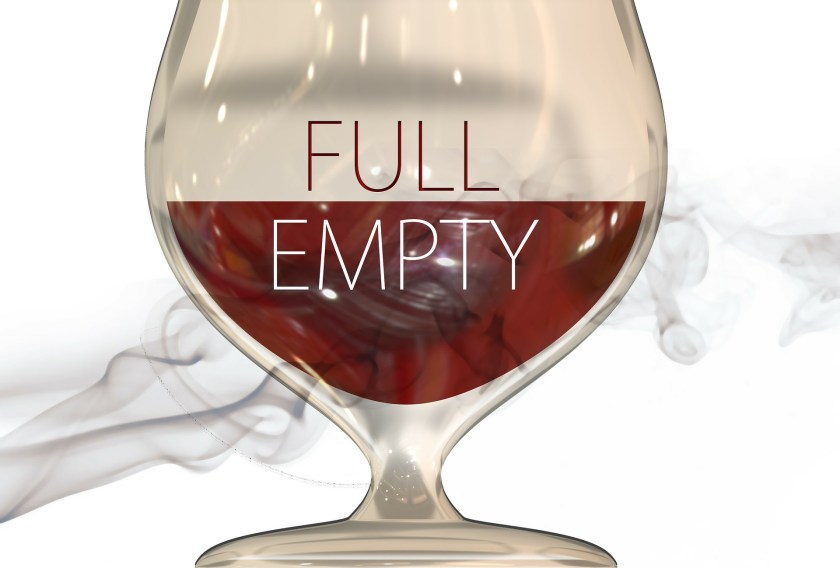
Are you a glass half empty or half full person? I confess. I can often be a glass half-empty person….a bit of a pessimist. Not always. It depends on what we’re talking about. I can also be a crazy glass half-full optimist. This expression is used so often now that it’s often just referred to as the “Optimist/Pessimist saying.”

The glass half-empty saying is an idiom. When you think about it, you realize it is used to illustrate that different people perceive a situation in different ways. Some optimistically. Some not so much. How you perceive a situation is based, to some extent, on your own experiences during your life. Some people have had experiences that have made them more an optimist than a pessimist and vice versa.

The glass half-empty principle really becomes interesting when you think of how attitude affects your health. If you always see the glass half-empty, then you have a pessimistic view of life. Can that possibly be healthy? Of course not! If you are an optimistic person, you wake up every morning and see the day filled with possibilities. You expect positive results from what you do each day. A study done consisting of a group of law students in 2012 found that the law students who were optimistic made more than $30,000 above their pessimistic counterparts. Optimism creates good fortune. If you are a pessimist and expect bad things to happen, it will be a self-fulfilling prophecy.

It’s a tough world out there and you can use the glass half-full/half-empty saying to help yourself out if you are trying to improve your life by…..let’s say……buying a home, getting a job, or something else equally difficult in this world of ours. First, avoid pessimists! They drain your energy and sap your self-confidence. Engage with people like an optimist. Carry yourself well. Don’t slump. Look good. Spiff up your personal hygiene — hair, nails, clothes. Smile and laugh. Laughter really is the best medicine. Think of that half-full glass and feel optimistic and smile. Laughter has all kinds of health benefits such as lowered blood sugar and blood pressure. Plus it makes you look good and feel good. Get some exercise. Take the dog for a walk. Exercise releases all those feel good endorphins.

We live in a world that tends to be a glass half-empty place. Be a glass half-full person  and you will be surprised what you can accomplish. #writing #amwriting #blogging #glass half-full #dailyprompt


Posted in Creative Nonfiction Essays

Map Quest

image

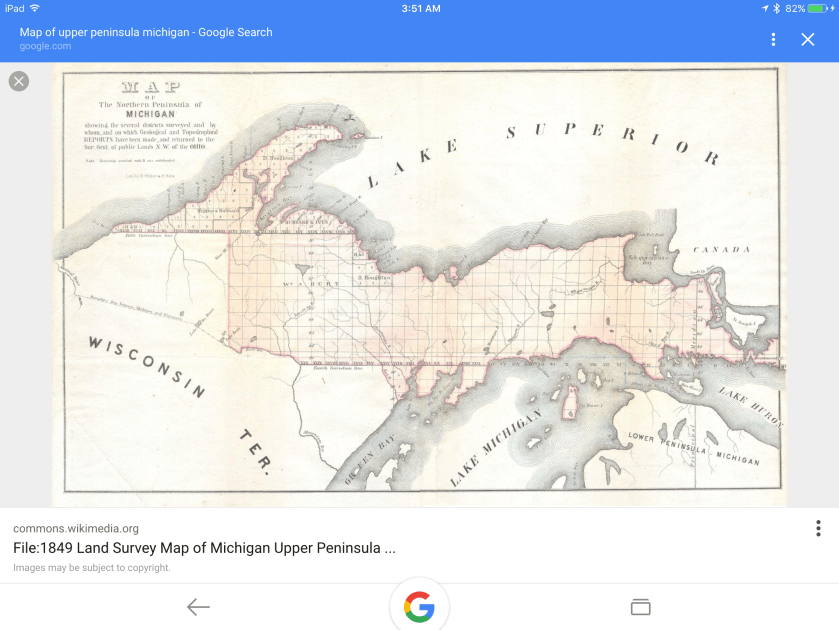
If you want to come see me, follow the map and these directions:

1. From wherever you are, go to Interstate 75 which runs north and south from southern Florida to northern Michigan. Go north on I-75. Be careful. No matter where you are on I-75, the traffic is heavy. It is the most heavily traveled interstate highway in the U.S.

2. Depending on where you get on I-75, you will see lots of beautiful scenery. From the swamps of the Everglades in Florida, through Georgia’s piney forest, to the foothills of the Appalachian Mountains in Tennessee and Kentucky. Next comes the Buckeye State of Ohio where you will find farming and manufacturing and, finally, Michigan, but Lower Michigan.

3. Lower Michigan is the mitten-shaped part of the state. I-75 will take you past Detroit and Flint, where I have relatives, then up through the central part of the state where my aunt and uncle made their home. A couple of more hours of driving and you are at the foot of the Mackinaw Bridge. It’s summer so the big bridge in the sky should be relatively easy to cross. In the winter, that is not always true. Of course, you can always get an escort to drive you across.

4.  When I went to the Upper Peninsula of Michigan for the first time, we took a ferry across the Straits of Mackinaw. The Mackinaw Bridge is the longest suspension bridge between two anchorages (the Lower and Upper Peninsula of Michigan) in the Western Hemisphere and is five miles in length. It carries four lanes of I-75.

5.  Keep going north as you pass St. Ignace on the northern side of the Mackinaw Bridge. Remember that you go north until you run out of I-75 which is at Sault Ste. Marie, MI on Lake Superior. When you get to Sault Ste. Marie, turn west on MI-28, heading toward Marquette, MI at the western end of the Upper Peninsula. You will be treated to a beautiful drive along the southern shoreline of Lake Superior. The lake is wild and the shoreline is rocky. The rocks are the most beautiful you will ever see. Stop and pick up some.

6. Some of the attractions along the southern shore are Pictured Rocks National Seashore, Grand Island, and Munising Waterfalls…..and much more. You can stop or continue on to see me.

7.  You are still on MI-28 but now you are getting close to Marquette, MI. Start watching for an old road on your right which is called Old MI-28. When you see it, turn right onto Old MI-28. You will see a group of log cabins along this road. My cabin is the third  one on the right along the lakeshore. Aren’t the birch logs that it is made out of beautiful? You are in Shelter Bay, MI.

You have found me at this beautiful spot. You’ll know it’s my cabin by the great big rock in Lake Superior right in front of the cabin. See all the cars out back of the cabin? My family is having a party. Come join us. There is just one caveat. You’ve found me, but it’s the six-year old me and the year is around the early 1960’s.

I visited this cabin in Shelter Bay, with my parents, often during my childhood and growing up years. My dad’s family would always rent it and I remember my time there as one  big happy party. My dad’s family believed in having a party and they could throw a good one. All my great aunts and uncles would show up along with most of my dad’s siblings. My mother, who grew up in the Kentucky Bible Belt, was decidedly uncomfortable, but she had to learn to cope.

The cabin front, facing Lake Superior, was glass on three sides with cots around the outside of the room. At six years old, I still remembered a lot. The porcupines that lived under the porch. The fact that there was an outhouse, not a bathroom, took some getting used to since there were black bears roaming at night and the porcupines. In the kitchen, everyone cooked on an awesome wood stove. I can envision my grandfather sitting in a big chair by the fireplace that was used year round.

What I remember most was the love in that cabin when we were all there. There was so much love that I felt enveloped in it. Some days, I wish I could go back to being six years old and in that cabin again. Like today. I’ve lost a dear friend under difficult circumstances. Lake Superior, my family, most of them gone now, and the love in that cabin is calling me. #dailyprompt #writing #amwriting #blogging #everydayinspiration


Posted in Creative Nonfiction Essays, creative writing, Dogs, Hunting, Non-fiction

The Cry of Hunting Dogs

image

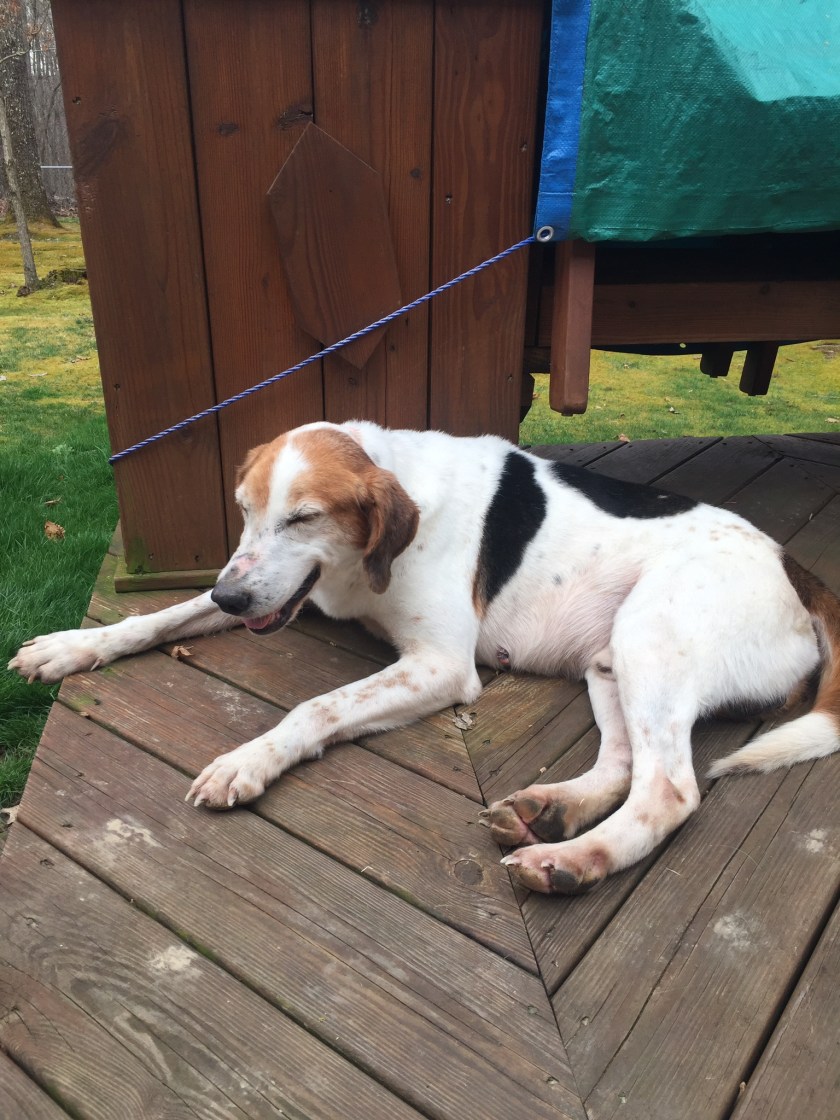
Meet Arlo. Arlo is not his real name. It was a name given to him by the rescue organization who found him, lost and alone….wandering……in a rural part of my county. It’s the time of year when hunters cull their dog packs. The old ones, the sick ones, the ones who can’t keep up anymore, well, they get thrown out. Dismissed. Thrown away from the only home they’ve ever known. To fend for themselves or die. Most die. Some get found by kindly strangers and get taken in. Some get rescued by organizations and find forever homes. Some of those die anyway because they have spent their lives so neglected and mistreated. Rescue organizations, at least in my area, are amazing at attempting to give these dogs a new life.

Arlo was a purebred Treeing Walker Coonhound. In his prime, he was, no doubt, a beauty. To me, he still was. Our local rescue asked me to be his foster mother and I agreed gladly. He was a tough case. Old. Ten years or more with more than one health issue.

i have no issue with hunting as long as it is done in a sportsmanlike way. I am not indicting all hunters as many are very kind to their dogs. Those who aren’t and who engage in animal cruelty spoil it for everyone. In my part of the world, some hunters tie their dogs out in a muddy yard to blue barrels, by chains, and starve them, thinking they will then be hungrier for the hunt. When the rescue organization found poor Arlo, he weighed 57 pounds, severely underweight for his breed. I could feel every rib and every vertebrae in his spine. He didn’t enjoy human contact. That took awhile. He did enjoy his dog food and stuffed toys and his cushy new bed.

Arlo developed severe skin lesions and hot spots. Worst of all, Arlo’s pads on his paws were almost gone. Yes, he had been hunted so hard his pads had been run right off his feet. We tried. We worked with the vet and tried to heal him. His skin got a little better but would not heal. You cannot put the pads back on a dog’s feet and his feet, and his joints, were so painful that he only walked or even stood when he had to. We all conferred and the decision was made to euthanize my precious Arlo. My husband and I had come to love him as our own. Such a beautiful and gentle hound.

When Arlo was with us, he would bay as the hounds do but in his sleep. I hope he is young, in no pain, and baying at the Rainbow Bridge right now. The cry of the hounds is a beautiful thing but not when they are crying because they are mistreated. #animalcruelty #animalabuse #hunting #kentuckyhoundsman #huntingdogs