Posted in Appalachia

Book Review: Hillbilly Elegy, by J.D. Vance

Update: This book has been made into a movie, directed by Ron Howard.

Before I start this book review, I feel the need to print a bit of a disclaimer. This book is about the area of the country in which I grew up. I grew up on the fringes of Appalachia, but I spent a lot of time with my grandparents who lived in Magoffin Country, KY, just two counties over from Jackson, KY, where the author spent at least part of his childhood. I don’t think I’m biased as I’ve spent most of my life in places other than Appalachia. But, I understand the culture and I am brutally honest about the culture. I have delayed writing this book review because the subject matter of the novel is so close to my heart as I’m sure it is close to the heart of J.D. Vance. With that said, here goes…..

Hillbilly Elegy: A Memoir of a Family and Culture in Crisis, by J.D. Vance is about a family who originated in Breathitt County, KY, squarely in the middle of the Appalachian portion of Kentucky (southeastern Kentucky). Breathitt County is poor, even desperately poor, white, and most of the people are, in their way, both hopeless and proud. This book is Mr. Vance’s memoir. However, J.D. Vance did up in Appalachia. He did not grow up in Breathitt County, KY. His family moved to Middletown, Ohio and that’s where Mr. Vance grew up. He was in Kentucky on occasion to visit relatives.

Hillbilly Elegy is a graphic portrayal of life in Appalachia, or perhaps I should say Eastern Kentucky, during the time Vance grew up. I’m speaking as one who was there at the same time as well as before and since. I know that the way Mr. Vance portrayed Eastern Kentucky is based on his truth and what he may have observed when visiting, but it is sensationalized and Hillbilly Elegy gives its readers a warped perspective of the area.

The people of Appalachia are good people. They are proud and they would be hard-working, if there were anywhere to work. Once the occupation of coal mining started to decline, unemployment skyrocketed. Industries simply seldom move into this part of Appalachia due to its relative geographic isolation, the lack of good roads, and a low educational level of the people.

Since work is so scarce, there have been periods of movement out of the area, and Mr. Vance’s family moved during one of those periods. The typical places to move have been to Ohio and Michigan. Mr. Vance’s family moved to Middletown, Ohio seeking a better life and work. Ultimately, they were seeking upward mobility. A generation or two before the period in which Hillbilly Elegy is set, upward mobility existed in Eastern Kentucky. That was during my grandparent’s time. During Mr. Vance’s time, upward mobility was difficult to obtain but certainly not impossible.

One fault I have regarding Vance’s book is that he gave no historical perspective on the Appalachian region. The Appalachia that I knew was not the Appalachia that Vance seemed to know. Those who experienced Appalachia before Vance knew a beautiful, peaceful place with people who immigrated mostly from Scotland, Ireland and England. The people were fiercely independent and self-sufficient because they had to be. They were farmers and, yes, coal miners, among other occupations. They were clannish and family-oriented.

Another problem with Mr. Vance’s book is that he depicted the people as either ignorant, drug addicts, alcoholics, lazy or some combination of all of these characteristics.
Vance couldn’t be more wrong. Even though many are uneducated, uneducated does not always mean ignorant. They are independent and self-sufficient and many were self-educated and went into the trades such as construction, plumbing, electricity, auto mechanics and more. Clearly, alcoholism and drug addiction were not part of their lives. A generation or two before Vance’s time in Appalachia, many were farmers, often tobacco farmers. Some of that ended when the price supports for tobacco were removed by the federal government. However, they farmed other crops. Corn, wheat, soybeans were some and they raised sheep and cattle. Unfortunately, Vance’s family must not have taken these paths.

Vance basically trashed the Appalachian area and the culture of the Appalachian people with little explanation or historical perspective. Hillbilly Elegy is a book based on one Appalachian family, not the entire area. Vance sensationalized those things he had been exposed to, but didn’t do his research on why things were as they were.

Yes, Mr. Vance’s family carried their culture with them when they moved to Ohio. What else were they to do? They knew nothing else. They were hot-tempered and quick to take offense. Perhaps that was because the culture in Eastern Kentucky developed in geographic isolation from the rest of the world. The family had addiction problems. When people can’t find work, that tends to happen. Those things went with them to Ohio as they are not solvable over night. They were “different” than their neighbors in Ohio. Of course they were. They came from a different place with different social norms and different values. It was hard to fit in, especially with people who called you a “hillbilly” and made fun of your accent. Vance’s family all struggled with their middle-class life in Ohio. They struggled to escape the demons of their pasts. They never did and my guess is neither did J.D. Vance. Hillbilly Elegy was the written testament to the chip Vance carries on his shoulders.

Vance’s family life seems chaotic to people who have never lived in the culture of Appalachia but not so chaotic to those of us who have. He did have the stabilizing influence of his grandparents on his mother’s side and that, perhaps, saved him. He went on to become a first-generation college student, a Marine, and he graduated from the Yale Law school. He is not the only young person to have escaped a disadvantaged background. He clearly had determination and intelligence as is evidenced in Hillbilly Elegy.

Vance, however, did not make it clear that the culture described in this book is not limited to Appalachia. Any poor, white, disadvantaged culture can fall prey to the cultural problems that Vance’s family experienced.

Hillbilly Elegy is a bestseller. My feeling is that it was written to be a bestseller by sensationalizing the bad and ignoring the good that exists in Appalachia. It is a social psychology look at a culture in crisis. If you want to read just one perspective on Appalachia, then read this book. Keep in mind that it depicts only the perspective of J.D. Vance. There are other books on Appalachia, the people and the culture that are much more well-rounded. Vance’s book is simply the story of one family.

#amwriting #amblogging #writing #HillbillyElegy #Appalachia

Posted in weekendcoffeeshare, Writing

#weekendcoffeeshare 12/10/2016

image

“Jenn, I’m so glad you’re back for our #weekendcoffeeshare! It’s been a long time since we’ve had coffee together,” I said as Jenn came through the door.

“Oh, I’m glad to be back. I’ve been gone too long. I’m anxious to hear what’s been going on. Let me help you serve everyone.”

“Thanks, Jenn,” I said.

As folks started coming round, Jenn and I served coffee, cappuccino, expresso. We also served apricot, chai, and Indian spice tea, along with hot chocolate. Everyone settled in with their hot beverage of choice. They were all glad to see Jenn.

Jenn started our coffeeshare by telling us about her recent trip to the Ft. Myers, Florida area, which is also one of my favorite areas in Florida. They had actually stayed in Punta Gorda but had visited one of my favorite Florida towns, Matlacha. It is a small, “old Florida” fishing village and one of the communities on Pine Island, FL, a place where Jenn and I have both vacationed many times. Matlacha has some of the best seafood restaurants and bars in all of Florida, in my opinion. Pine Island is also one of my favorite places to vacation, at least on the Gulf side of Florida. Great deep sea fishing and sightseeing to the outer islands. The best grouper I’ve ever eaten. A quiet old Florida culture.

I wish I was in Matlacha right now! It’s getting cold in Kentucky. Last night was in the low 20s and today, we’ll be lucky if the temperature gets out of the 20s. The dreaded polar vortex has decided to pay us another visit as it did last winter. Kicks my seasonal affective disorder and newly-discovered claustrophobia right into high gear! Maybe I’m getting used to winter. I’ve haven’t noticed it as much this week.

I want to tell you about the most interesting book I’m reading. Writers have to read, of course. It’s called Hillbilly Elegy by J.D. Vance. Some of you may know that I come from an area of the country very near to Appalachia. Vance wrote this novel about Appalachia, his home, and it is an excellent story and also a good look at the culture of the area. If you’re interested in Appalachia or just in different cultures, give it a look. It really is a good story. I hear it isn’t terribly popular in the Appalachian region. Vance doesn’t always paint a flattering picture of the culture but what culture doesn’t have unflattering aspects? If you are interested in the Appalachian culture, try books by the author Silas House who is a good writer technically and knows the culture inside and out. House is a wonderful storyteller.

I have gotten very little work done on my novel this week. This novel seems to be so character-driven. The characters have taken on a life of their own and, in any psychological thriller, there are a number of twists and turns. One character has caused a major twist this week. I have to see where this one takes me.

I’ve been really fond of listening to classical music this week in my writing studio. Do you find that music with lyrics disturbs your writing? I surely do. So classical or jazz it is. Sometimes, I prefer silence. I moved out into my writing studio to escape the television in my house. I do have a television in my studio but, so far, I’ve only turned it on for the news. There is so much news, these days, that I sometimes watch too much of it.

We know, as writers, we all need a good printer. I finally broke down and ordered a Brother Laser Printer. I can’t wait for it to arrive. I’ve used a problematic Epson Inkjet for a long time now and I am so tired of buying the extraordinarily expensive ink cartridges. I was shocked at how far down the price of the Brother printers have come. You can also get wireless ones, which I did. If you’re interested, I encourage you to check them out. The price is more than reasonable.

I may have another cool “writer” purchase to tell you about next weekend!

That’s it for this weekend. I have to wrap-up our coffeeshare a bit early. I’m doing something exciting today. I’m going, with my girlfriend, to a performance of the ballet, “The Nutcracker,” at the Lexington Opera House, this afternoon! I’ve never seen it so I’m super excited, I will tell you all about it next week.

Have a great week and a productive writing week! #amwriting #amblogging #writing

*This post is sponsored by parttimemonsterblog.com

Thanks, Diana!


Posted in Appalachia, Eastern Kentucky

Appalachia: The Foxfire Books and Magazine


image

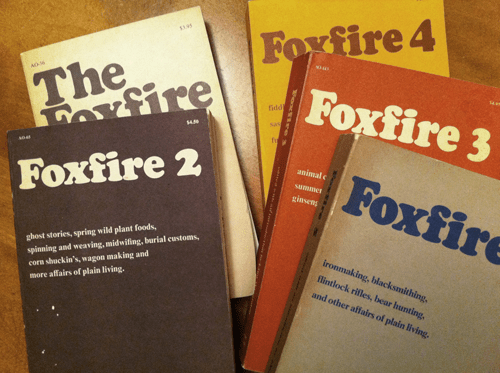
The Foxfire Magazine and the Foxfire series of books are some of the most fascinating works you will ever read on the culture and traditions of Appalachia. The Foxfire Magazine was started in 1966 in Rabun County, GA and was the result of a writing project by one of the teachers at Rabun Gap Nacoochee School in that county. The students were challenged by their teacher to interview local people about Appalachian customs and write an article about what they discovered. What happened was a phenomenon. The stories told to the students about different bits of Appalachian culture were so fascinating that by 1972 they were gathered together in book form and published. It became a bestseller and brought attention to the Appalachian region and the Foxfire project.

Before the books came the Foxfire magazine. It was a compilation of the stories told to the students assigned this project in Eliot Wigginton’s English class. This magazine has been in publication continuously since 1966. The name “foxfire” came from a naturally occurring bioluminescence in fungi in the mountains of North Georgia.

Gradually, there were so many stories about crafts, folklore, recipes, Appalachian history, and culture, that a series of books were developed. The first book was an immediate bestseller when it was published in 1972. Other books were published and the proceeds were used to develop the Foxfire Project. There are now eleven companion volumes to the original Foxfire book.

The Foxfire Project has been able to build an Appalachian Heritage Center in Georgia. It is the repository of material having to do with Appalachian culture and, of course, the Foxfire books and magazines. It also is a source of learning for teachers about experiential teaching and learning, which is what allowed the Foxfire Project to be born. Much later than 1966, experiential education became commonplace in high schools and colleges.

The Foxfire Project, books, and magazines are true Appalachian treasures. You can find how to subscribe to the magazine and donate to the project at FoxFire Project. You can find the fascinating Foxfire series of books wherever books are sold. #foxfire #amwriting #writing #blogging


Posted in Appalachia, Eastern Kentucky

Book Review: Clay’s Quilt

Clay Sizemore, a young coal miner who lost his mother at a young age, is the main character of Clay’s Quilt. This novel by Silas House, a renowned Kentucky author, was House’s debut novel in 2001. I’m reviewing this book for you because it is one of the best novels I have ever read. It is worth reading whether you are interested in Appalachia or if you are just interested in reading a good novel. If you like a heart-wrenching story, populated by colorful characters, and set in the most difficult of environments, you will enjoy Clay’s Quilt.

The story is a microcosm of life in Appalachia based on this one Eastern Kentucky family but it will strike a familiar chord to members of all Eastern Kentucky families. I know this writer, at times, felt like I was reading about my own family.

Free Creek, the setting for the novel, is located in the hills of Eastern Kentucky, near coal mining operations. Young men like Clay Sizemore and his friend, Cake, are born here and never expect, or want, to leave. They settle into their occupations, raise a family, have a big extended family full of aunts and uncles and nieces and nephews, and this is their life. It can be a very good life. It can also be a hard life, but these people, the people of Appalachia, don’t know that. This is all they know and they wouldn’t have it any other way.

Clay Sizemore lost his mother in a tragic car accident when he was three years old. That day, an icy and snowy winter day, Clay’s mother decided she was going to leave her husband. She took Clay with her and lost her life on slick roads. His extended family closed ranks around him and raised him from the age of three. After that day, Clay never knew his father. He had his beloved Aunt Easter, who took care of him as a boy. He also had Uncle Paul, who made quilts, and Dreama, his cousin who he loved like a sister.

Clay became a hard-working coal miner. He worked in the mines during the day, but on the weekends, he and Cake went to the local honky-tonk, drank their fill, and listened to their mountain music. There he met the beautiful Alma, a fiddler with whom he wanted a future, but Alma had her own problems. Most importantly, Clay had a box of his mother’s possessions from which he tries to put together her past, hoping to figure out who she was and who he is. During this time, Uncle Paul is making a quilt – out of the pieces of Clay’s mother’s clothes.

This is a beautiful story written by Silas House in lyrical prose. It is short on sentimentality and long on descriptive characterizations and good storytelling. It is easily readable in a weekend. Clay’s Quilt is a stunning and mystical novel that will stay with you for a long time after you read it.

You can get the Kindle edition at amazon.com or the hardcover or paperback at Abe Book’s. Enjoy! #writing #am writing #blogging #appalachia #Best_Books

Posted in Climate Change, environment, Uncategorized

Book Review: The Sixth Extinction: An Unnatural History

I just finished reading a book that I have to tell you about. It is a 2015 Pulitzer Prize winner and I can see why. The Sixth Extinction: An Unnatural History, by Elizabeth Kolbert, is a quiet storytelling of possibly the last extinction the Earth will know. Anyone interested in the environment, climate change, history, geography, or just the world in general will likely find this book interesting.

Even our children, in their fascination with dinosaurs, study mass extinction events; specifically, the asteroid event that wiped them out. There have been other mass extinction events in the last billion or so years. The premise of Kolbert’s book is that the sixth extinction event may be the last.

I don’t want to ruin the book for you. It is a wonderful, well-researched, very readable account of the Earth in terms of the environment. Kolbert draws on the work of geologists, botanists, climatologists, biologists, historians, geographers, and more and pulls it all together. It is a five-star read, in the opinion of this writer. #Elizabeth Kolbert