
Posted in Appalachia, Holidays, Mother's Day, Uncategorized

Mother’s Day: Founded in Appalachia

image

Mother’s Day, an important holiday to many of us, originated in Appalachia. It was founded in 1858 by Ann Jarvis. The founding of Mother’s Day was in response to the need for sanitation for new mothers since the infant mortality rate at that time was so high. Infection spread easily through mining camps and the small communities. Diseases that were prevalent were small pox, tuberculosis, whooping cough, measles, typhoid, and diptheria, to name a few.

After the Civil War in 1865, a woman named Julia Ward Howe who was both an author and an activist, wrote the lyrics to the Battle Hymn of the Republic and her husband was responsible for trying to clean up the unsanitary conditions that existed during and after the Civil War in the army camps. More men died in the camps from unsanitary conditions than were killed in the war. Howe wrote the Mother’s Day Proclamation which urged all mother’s to leave their homes for one day in June and work for peace in their communities. There existed two versions of Mother’s Day.

In May 1908, Anna Jarvis, the daughter of Anne Jarvis who established the initial version of Mother’s Day, worked tirelessly to see her mother’s vision fulfilled. She enlisted the help of others to get an official day established honoring mothers. In 1912, West Virginia became the first state to recognize Mother’s Day. Finally, in 1914, President Woodrow Wilson signed a proclamation declaring the second Sunday in May a national holiday — Mother’s Day. Its symbol became the carnation.

By the 1940s, Anna had soured on Mother’s Day as it was celebrated in modern society, particularly its commercialization. She passed away without ever becoming a mother.

Mother’s Day lives on and we celebrate our mother’s, or their memory, every year…..all thanks to a woman from Appalachia. #mothers day  #appalachia


Posted in Horse Racing, Horses, Kentucky Derby, Triple Crown, Uncategorized

Racing to Die: Drugs and Inbreeding in Thoroughbred Racing


image

I am a Kentuckian who loves horse racing, who loves the Kentucky Derby , who loves the whole Triple Crown experience. I love horses, all horses but particularly thoroughbreds. I don’t love what has happened to thoroughbred horses in the name of racing and making money.

In the 2015 Kentucky Derby, a horse named Eight Belles broke down and had to be euthanized after the race. After the 2015 Derby, there was a Congressional Hearing in the House of Representatives by the Subcommittee on the State of the Thoroughbred Racing Industry and the Welfare of the Thoroughbred Horse due to Eight Belle’s breakdown. They specifically addressed drugs and inbreeding in the racing industry.  Breakdowns on the track and during or after a race are becoming increasingly common. This subcommitte investigated the Eight Belle’s situation and determined she was inbred to the point that there was no way she could possibly have been a sound horse. Her four times great-grandfather on her sire’s side was her three times great-grandfather on her dam’s side. That particular line of horse was known for their weak ankles even though they were superb race horses. What happened to Eight Belle’s to cause her breakdown? A catastrophic ankle injury. There are thousands of race horses out there with the same blood line as Eight Belles or very similar.

Inbreeding is not the only problem. Performance-enhancing drugs is the other leg of this issue. Race horses bleed from their lungs and suffer inflammation and pain. Are they rested or retired? No. They are raced on drugs. Lasix for the bleeding in the lungs.   Anti-inflammatory drugs and pain medications for the other problems. Bottom line? Even if a race horse is hurting, he or she is out there on that track running because they are shot up with drugs and do not feel the pain. It’s called doping.

Different race tracks have different rules regarding drugging horses. Churchill Downs, where the Kentucky Derby is run, follows Kentucky rules, and Kentucky is known as the most lenient state. Horses entered in the Derby can be doped with Lasix for bleeding in the lungs, corticosteroids for pain and inflammation, and phenylbutazone for inflammation. This writer’s opinion is that these drugs should not be allowed to be used during a race on these horses. Even more, horses that require the use of these drugs should not ever be bred as that is only exponentially extending the problem to future generations. The main issue? Virtually all race horses are doped with these drugs in this day and time. In Europe, however, horses run clean, breakdown less, and are generally healthier.

Back to the inbreeding issue. It isn’t simple. Inbreeding and linebreeding are used in order to reproduce desirable characteristics in horses, but it also reproduces undesirable characteristics such as in the case of Eight Belles. To this writer, there seems to be little solution other than to outcross. Outcrossing is breeding unrelated horses through four generations. It is risky and breeders certainly have to do a great deal of research and homework. Outcrossing can bring new blood into a line and make it stronger but it takes work and study on the part of the breeder.

If something isn’t done, and fast, about the drug and inbreeding issues, horse racing as we know it is going to die. Average starts per horse dropped from 1975 to 2007 by 62%. Around 10 starts in 1975 to a little over 6 starts in 2007. Compare that to the starts by the great horse Citation. He was born in 1945 from a primarily outcrossed European breeding and started 45 times with 32 victories. He is considered perhaps third on the list of the greatest race horses that ever lived, behind Man ‘O War and Secretariat.

Could most thoroughbred race horses today run 45 races? I will let you draw your own conclusions. I hope for a National organization to regulate horse racing and the treatment of race horses that standardizes the laws across all 50 states.

Posted in Non-fiction

Kentucky Derby Week: American Pharoah

image

It’s Kentucky Derby week! The Week of the Horse. Even though some say horse racing is on the wane, you would never know it this week. In fact, you would never know it in Kentucky at all. Kentucky is the thoroughbred horse capital of the world though others try, on occasion, to steal that claim to fame. They have never succeeded! Particularly not after the 2015 Kentucky Derby. America and, perhaps the world, fell in love with a plain brown colt named American Pharoah. Even his name was misspelled! But Pharoah didn’t let that or anything else stop him. He won the Kentucky Derby, and then the Triple Crown coupled with the Breeder’s Cup Classic. He was the first Triple Crown winner since 1978 when Affirmed won it and the first Grand Slam winner ever…….the Grand Slam being all four races.

What is so special about this brown colt, born and bred in Kentucky? Some horses are just special. Secretariat was special, like Seattle Slew and Man ‘O War were special. Pharoah has a gentle temperament. Thoroughbred horses are known for many things but a gentle temperament is not one of them. Instead, many are temperamental and nervous. Pharoah loves his adoring public and during his racing seasons, and now while he is standing at stud, his public goes to visit him in hordes.

Something else special about American Pharoah. For over 40 years, horse racing has been trying to find another Secretariat, that very special big red horse that won the Triple Crown and broke all speed records. Secretariat certainly posted a faster time in the Belmont Stakes than Pharoah, but unbelievably, Pharoah actually accelerated in the final quarter mile of the Belmont, won the race going away, and beat Secretariat’s quarter mile time by 0.68 of a second.

I personally know Pharoah loves his tribe because I am one of them and I have visited Pharoah at his home at Ashford Stud near Versailles, KY. He poses for the crowds, tall and proud. He is not a bit nervous but very calm. When you get close to him, he has a kind, quiet look in his eyes and he meets your gaze lovingly. He does not shy away. They say that now, even during his breeding season, he is still our calm, sweet Pharoah even while getting at least 80 mares in foal. I can’t wait for his first foal.

In some ways, American Pharoah revived horse racing. He retired to stud with a record of 9-1-0. Not only does he have a breeding career ahead of him, you can’t turn around in Kentucky without seeing someone wearing some piece of American Pharoah merchandise……a jacket, a cap, or something.

They say he loves to go out in his paddock in the mornings before his breeding and public visiting sessions and have a run and a good roll in the mud. Just once, I would like to climb over that paddock fence onto his back, go for that run with him, feel his powerful muscles, and see the world through those big brown eyes. #anericanpharoah #kentuckyderby #triplecrown

Posted in Appalachia, Drug abuse, Eastern Kentucky, Poverty, Uncategorized

Appalachian Roots

I am from Appalachia, central Appalchia to be exact. Northeastern Kentucky to be even more exact. My roots have a bit of a split personality. Part Appalachian, part Swedish! What a combination which probably accounts for my split personality and eccentric leanings. Someday, I will write about my Swedish family. Now I want to write about Appalachia. Appalachia breaks my heart.

I have always lived geographically close to Appalachia and spent almost 30 years teaching students who came from the region. I did not grow up deep in the heart of Appalachia but I frequently visited my grandparents and other family who lived in the Central Appalachian region. As I grew up, their culture was my culture, their values were my values, their way of life was my way of life. By the time I was becoming a teenager, Appalachia’s best days were behind it but I didn’t know it. My grandfather had worked hard to insure that his eight children, including my mother, had left the region in order to get an education and seek their fortunes. One had to go elsewhere for an education. There were only two universities reasonably close by and the terrain of the region is geographically isolating.

Poverty was the calling card of the region. My grandfather was a landowner, a successful farmer, and had gas and oil wells on the rich land. When I looked out his front door, I saw acres of corn and tobacco growing and many dairy cattle grazing. He was the exception not the rule. He refused to let his family work in the coal mines, but coal mining was one of the principal industries. Much of the region is not suited for farming as it is too mountainous. Manufacturers did not bring their industries to Eastern Kentucky. There were no good roads.

The people opposed interference from outside the region. They feared that their culture would be taken away, their way of life stolen, their children corrupted. They feared cultural change more than they feared poverty.

My grandparents are gone now but the old farmhouse still stands. Do you know what I see when I look out the door now? Trailer parks. Very poor, hopeless people. Children playing in the dirt yards. Starving dogs surviving on table scraps tied out in the yard. I know enough about the area to know what lies within some of those trailers. Drugs. Heroin. Pain pills. In that county, there is little economic activity with around a 33% unemployment rate. Farming is gone. The gas and oil wells still pump but the owners of the mineral rights live far away or the mineral rights were unfortunately sold along with the land. The people lost their way of life but not to manufacturers or education. They lost it to drugs and poverty.

Appalachia breaks my heart. #appalachia #poverty #drug abuse

Watch this space for much more on Appalachia.


Posted in Politics, The Economy

Will the Economy Affect the Presidential Election?

I’m tired of the word “circus” when describing the 2016 Presidential election. It’s much worse than a circus as the connotation of that word is an event that includes fun and games. Even though the whole thing has seemed funny at times, the future of our country is at stake. When we finish laughing, suddenly it seems very serious. Will the current state of our economy affect the outcome of the 2016 Presidential election? In a perfect world, the voters would be looking at issues like the jobs report, inflation, interest rates, and a myriad of foreign policy issues. Have we heard much or anything about those issues this year? Not so much.

Oh, you can argue that we hear about foreign policy but all we hear is about terrorism and a little about immigration. Both are crucial issues but do we hear any real plans for either? Nothing sustainable. We already have immigration laws on the books that are not being enforced. We hear about a wall that may be built if a certain candidate is elected. The only thing we seem to know to do about terrorism outside of our borders seems to involve way too many innocent people.

Regarding domestic policy, there is very little discussion of policy positions except those that are either ultra-liberal or ultra-conservative which may not represent the majority of the American people.

I have heard little about the fact that, instead of rising, the Gross Domestic Product of the U.S. fell by 0.5% in the first quarter of 2016. In 2015, the pundits were predicting a roaring 2016 economy. Not happening. The job market. Last fall, we reached a 40 year low of the number of Americans participating in the job market at 62.4%. That has gone up slightly to 62.9%. Even though we added over 200,000 jobs during March 2016, the jobs are simply replacing jobs long since lost. Inflation. Core inflation increased 2.2% on an annual basis in March 2016 and 2.3% annually in February. Not much talk about these key issues that affect each of us.

Instead we get slogans and platitudes. Mudslinging and name calling.

Is the state of our economy really affecting the election? People certainly seem angry. Is what they are angry about……wages that don’t cover expenses, high cost of health insurance, terrorism….just to name a few….really something any of the candidates can do much about? Or has it all gone too far? Food for thought. #Hillary #Trump #presidentialelection #economy

Posted in Creative Nonfiction Essays, creative writing, Dogs, Hunting, Non-fiction

The Cry of Hunting Dogs

image

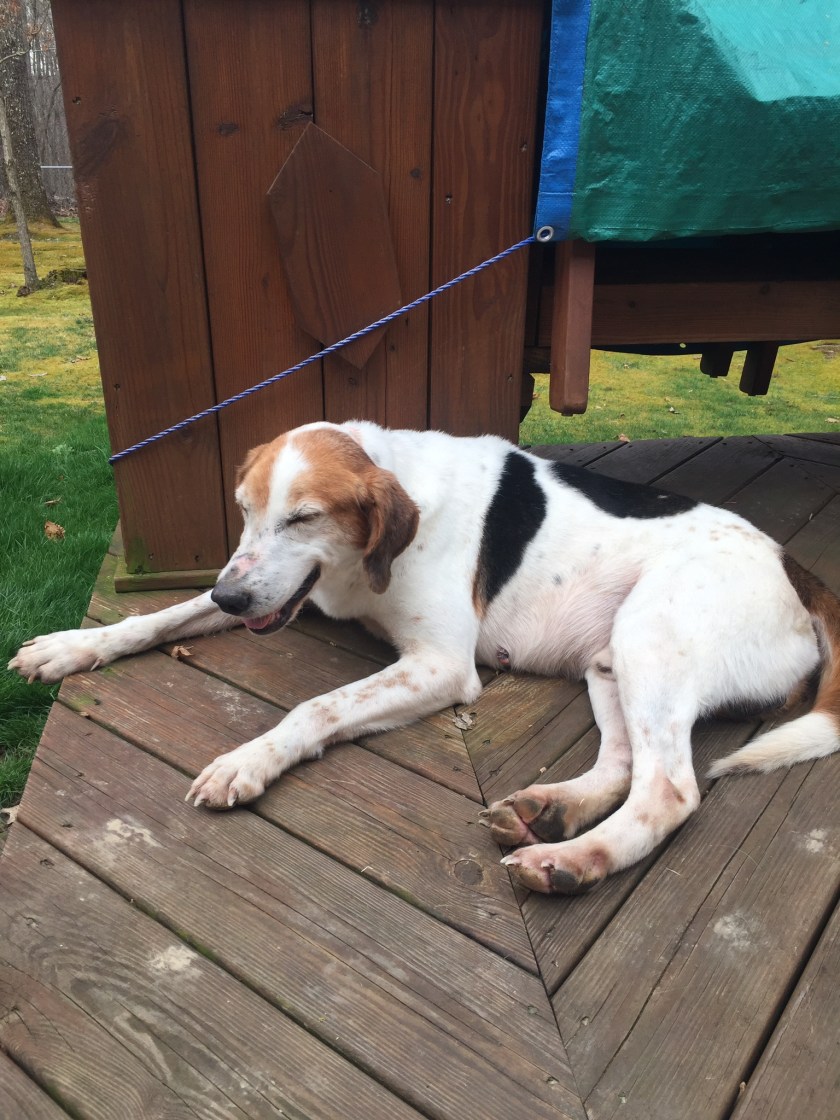
Meet Arlo. Arlo is not his real name. It was a name given to him by the rescue organization who found him, lost and alone….wandering……in a rural part of my county. It’s the time of year when hunters cull their dog packs. The old ones, the sick ones, the ones who can’t keep up anymore, well, they get thrown out. Dismissed. Thrown away from the only home they’ve ever known. To fend for themselves or die. Most die. Some get found by kindly strangers and get taken in. Some get rescued by organizations and find forever homes. Some of those die anyway because they have spent their lives so neglected and mistreated. Rescue organizations, at least in my area, are amazing at attempting to give these dogs a new life.

Arlo was a purebred Treeing Walker Coonhound. In his prime, he was, no doubt, a beauty. To me, he still was. Our local rescue asked me to be his foster mother and I agreed gladly. He was a tough case. Old. Ten years or more with more than one health issue.

i have no issue with hunting as long as it is done in a sportsmanlike way. I am not indicting all hunters as many are very kind to their dogs. Those who aren’t and who engage in animal cruelty spoil it for everyone. In my part of the world, some hunters tie their dogs out in a muddy yard to blue barrels, by chains, and starve them, thinking they will then be hungrier for the hunt. When the rescue organization found poor Arlo, he weighed 57 pounds, severely underweight for his breed. I could feel every rib and every vertebrae in his spine. He didn’t enjoy human contact. That took awhile. He did enjoy his dog food and stuffed toys and his cushy new bed.

Arlo developed severe skin lesions and hot spots. Worst of all, Arlo’s pads on his paws were almost gone. Yes, he had been hunted so hard his pads had been run right off his feet. We tried. We worked with the vet and tried to heal him. His skin got a little better but would not heal. You cannot put the pads back on a dog’s feet and his feet, and his joints, were so painful that he only walked or even stood when he had to. We all conferred and the decision was made to euthanize my precious Arlo. My husband and I had come to love him as our own. Such a beautiful and gentle hound.

When Arlo was with us, he would bay as the hounds do but in his sleep. I hope he is young, in no pain, and baying at the Rainbow Bridge right now. The cry of the hounds is a beautiful thing but not when they are crying because they are mistreated. #animalcruelty #animalabuse #hunting #kentuckyhoundsman #huntingdogs

Posted in Music, Uncategorized

Can Music Heal Anxiety?

Do you remember the song “American Pie” by Don McLean? As a child of the 70s, it has always been part of the background of my life and the lives of my compatriots. I reference that song because I am a believer in the power of music as a healing force in our lives and it has two very powerful lines in it. We all have “our” music. Many children of the 60s and 70s are into classic rock. The 80s were pop with the emergence of rap and hair metal. The 90s – a plethora of genres including a new sound in rock along with pop, metal, and pop, and so on. Country has always been with us though a new sound emerged in country pop.

When I listen to my music, I am relaxed and happy. Science tells us why. Studies have shown that the sensory pathways along which music travels in the brain compete, for example, with the pain pathways and win. Music can reduce pain. When feeling anxious, studies show that if you listen to music that makes you feel the way you want to feel, it helps you feel that way. So listen to happy music if you want to reduce your anxiety. Music has proven therepeutic in all sorts of clinical settings.

In “American Pie,” there are the lines, “do you believe in rock and roll, can music save your mortal soul.” My answer to both questions is a resounding yes! At the very least, your music can soothe your soul and your anxiety.


Posted in Living Life

On Being Careful

We live such careful lives these days. We ride our bikes and wear helmets. We drive our cars and wear seat belts. It seems that we strive to not only be politically correct at every turn but to live our lives in a “middle of the road” kind of way. We want to achieve balance between work and home, between the personal and the professional, between the fun stuff and the stuff we think we have to do. Where has the spontaneity gone? The passion? Why don’t we throw caution to the wind anymore? What are we afraid of?

I think it may be all about money and what isn’t about money may be about fear. We are afraid to throw caution to the wind and live spontaneously because what if something unexpected happens? What if we ride our bike with no helmet and get hurt? I see a cascade of money resulting from that decision. Do we have health insurance to take care of that injury? What if we have a head injury and are permanently impaired? Then we can’t work and make money. Who will care for us and how? Money and fear. All because we just jumped on our bike one day and took a ride up the street without a helmet.

In a more innocent time, such fears never occurred to us.

These fears have dulled our passion for life and its joys. We think many frames ahead. We plod along, living the life we think we want or have to live, and we don’t have the fun we want to have because of fear. Live your best life. Don’t be afraid. You only have one.

Posted in Introduction

Analytical or Creative?

I have been a writer all of my life, taking time out to be a college professor for most of 30 years. Even then, I wrote about my field for the popular press, usually not cool for the academician, and I also engaged in academic writing as a good a ademician should. Never got around to the creative stuff, though it was always in my head.

Now that I am writing freelance, I am going to do both…..some creative writing for my own pleasure like this essay. Who knows, maybe I can even get a publisher interested.

I have to keep food on the table, so my analysis and reporting of the goings on in business and business finance will continue. It’s fascinating, particularly in this new political climate in which we find ourselves. Big economic implications will arise. I will try to make sense of all of that and more. Here is my latest article on startups. I may even try my hand at a few ebooks.

Please comment and let’s have a conversation. I will enjoy getting to know you. Come back often.

image