Posted in Challenges, Fiction, Flash Fiction, Horses

She Ran Calling Wildfire

img_0417

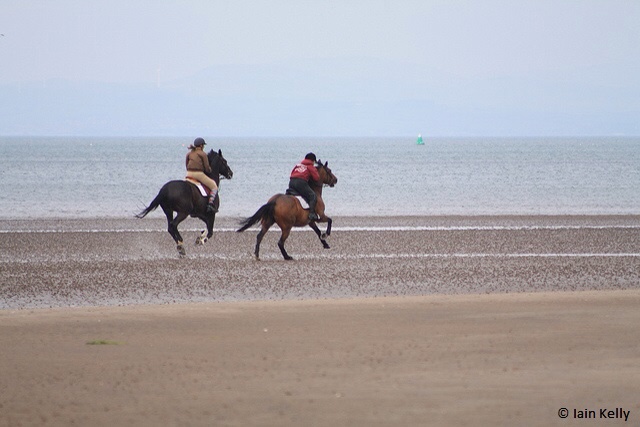
It was early morning when I went to the barn to saddle him. It had been a year since the barn fire. We had pulled him out of that fire but he had lost his left eye. It took almost a year before I could get on his back again. His body was healed, that big, dark body, but I didn’t think his mind would ever be. Other horses always had to be on his right, else he was scared.

We went for a ride with Robert along the beach. Wildfire loved the beach. For the first time since the fire, he stretched his neck out and ran like the wind coming in off the ocean. The ocean was healing his soul….and mine.

124 words

#amwriting #amblogging #writing #FFfAW #Challenges #flashfiction #fiction

*This post part of the #FFfAW Challenge – Flash Fiction for Aspiring Writers

Photo Credit to Iain Kelly

Posted in Fiction, Flash Fiction, Horses

Wildfire and Rose

img_0388

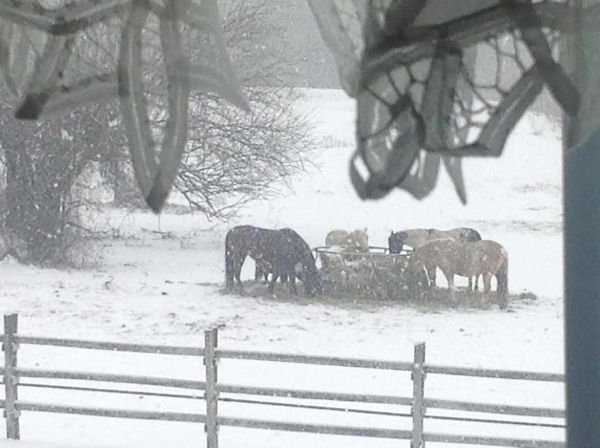
“It’s going to be 19 degrees F. tonight and not more than 21 degrees tomorrow. We have to get the horses in,” Skip said.

“Especially Wildfire,” I replied. “His coat seems thin this year. He’s not out there with the other horses. I’m going to take Thunder and go to the back pastures to find him.”

“You can’t,” said Skip. “It’s so slick out there. What if Thunder slips?”

An hour later, Rose hadn’t returned. She would search for her beloved Wildfire until she found him. Suddenly, they heard a whinny. Wildfire was covered in snow by the door. So was Rose!

Photo credit Rochelle Wisoff-Fields

100 words

#amblogging #amwriting #writing #flashfiction #fiction

Post in response to #FridayFictioneers Challenge

Thanks, Rochelle!


Posted in Emotional Child Abuse, Horses, Memorial Day, Uncategorized

A Child’s Salvation — the Horse

image

It’s the week of the Preakness and perhaps that’s why I’m thinking about horses. The Preakness is important here in Kentucky. It’s the second jewel in the Triple Crown and this girl hopes Nyquist will wear it. Not only am I thinking about horses but I’m also thinking about horses and their people…..and the relationship between people and horses and how important that can be to both.

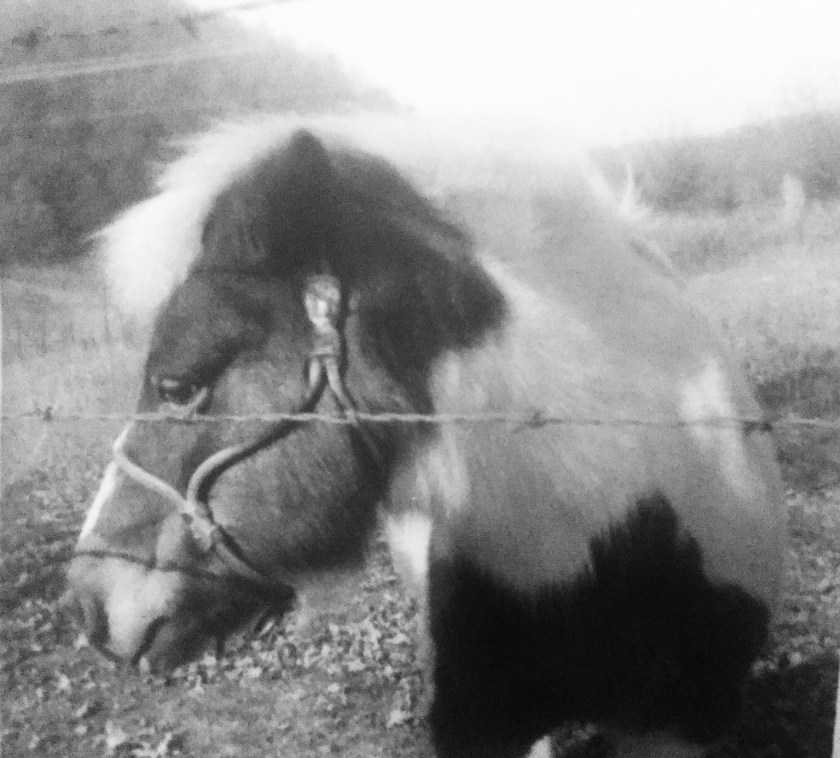
Long ago, so long I can hardly remember, I knew this little girl. She had two ponies during her childhood and, later in life, a horse. Meet her second pony, Mr. Ed, named after a rather famous TV show that aired back in the day. Her first pony didn’t work out for her as he was a stallion and her Daddy was terrified the stallion would kill her as he was pretty temperamental. Only she and the stallion knew the secret that it was really fine. The stallion went off to live at a farm and her Daddy brought Mr. Ed into her life.

The little girl didn’t take riding lessons until much later in her life. She seemed just to know how to ride. Mr. Ed was a Shetland pony but a rather large one. He was kind and gentle but fun for the little girl to ride. Sometimes, when he didn’t want to be ridden, he would just lie down on his side. The little girl would just laugh and jump off his back, barely in time, to avoid being crushed. The little girl’s Daddy watched in helpless wonder. She wasn’t even 10 years old.

Riding Mr. Ed wasn’t the most important thing to the little girl. You see, the little girl had some problems. She would not have described it like this, but in adult words, she and her mother did not have a very good relationship. Her mother was a sad and depressed woman. Probably clinically depressed though, then, that diagnosis didn’t even exist. She seemed to take her sadness and depression out on the little girl.

The little girl’s mother made the little girl feel unloved, like she wasn’t good enough, like she had to do better and better, be smarter, be prettier, than anyone else and maybe then her mother would love her. She was too young to understand that nothing she did was ever going to make her good enough, pretty enough, smart enough, to please her mother. Nothing was going to make her mother love her. She didn’t understand that the problem was with her mother, not with her. That understanding took years.

Mr. Ed was the little girl’s salvation. She would run to his red barn, in the moments she could get away from her mother, and she would sit in the straw, hiding in the corner of the barn. She would cry and talk to Mr. Ed. He would stand there, eating his oats and hay, and listen. Sometimes, he would even lie down with his head close to the little girl and sleep while she talked. She hid there as long as she could, away from her mother.

When the little girl grew into a teen-age girl, Mr. Ed watched for her to come home every day from school. She would go for a ride after school and stay with him as long as possible, even in the winter. He was still her best confidante. His barn was still her hiding place, away from the hurtful comments and the hateful face of her mother. She grew into quite a loner, preferring the company of animals to people. She had a hard time relating to most people. Her Daddy worked away from home most of the time and he was not there for support. She had a wonderful aunt and uncle close by, but the influence of her mother was too much and that of her aunt and uncle was not enough.

The teen-age girl started college and graduated early. She wanted to get a job and leave home as soon as possible. She, with her Daddy’s help, made arrangements for Mr. Ed before she left. He was old by the time she was 20 and ready to leave home. He had developed some laminitis in his hooves. He went to a farm owned by a large animal veterinarian in a nearby town, though he didn’t live long. The hoof problem was too severe.

The grown woman the little girl became will never forget Mr. Ed. She loved horses from then on. Mr. Ed had helped save her life and made intolerable emotional abuse almost tolerable.

If you are a mother who feels depressed or overwhelmed, go to your doctor and get help. If you are an adult child who suffered emotional abuse, contact the National Association of Adult Survivors of Child Abuse.

Posted in Horse Racing, Horses, Kentucky Derby, Uncategorized

My Connection to Nyquist, the 2016 Derby Winner

image

When I was a girl, I had a favorite horse. I learned to ride at a young age, followed horse racing when I was a teenager and ever since, and had a subscription to The Blood Horse younger than anyone had a right to. My favorite horse was a thoroughbred named Crimson Satan. Why? My Dad, who fulfilled every wish I had that he could, took me to visit the farm where he lived, the former Crimson King Farm and I fell in love…..with the horse. We went back over and over again up until Crimson Satan turned three and to my delight, he was entered in the Kentucky Derby.

I followed every race he ran and everything he did as he prepped for the Derby. In 1961, at two years old, he was the two year old champion male horse of the year. That award no longer exists. In 1962, he ran in each of the Triple Crown races, running sixth in the Derby, seventh in Preakness, and third in the Belmont Stakes. At my age then, I thought he was the most wonderful horse that ever lived. He went on to become a very successful sire and produced a granddaughter that sold at the Keeneland sales for $7 million in 1985.

Why am I talking about my childhood horse friend, Crimson Satan, on Derby Day, 2016 when Nyquist just brilliantly won the Kentucky Derby? You see, I am a horse pedigree freak. I always research horse pedigrees. I researched all the Derby horses, including Nyquist and much to my surprise, I found out that Nyquist 4X great granddam, on his dam’s side was a horse named Crimson Saint whose sire was MY childhood horse friend, Crimson Satan, Nyquist’s 5X great grandsire. I thought nothing could have endeared Nyquist to my heart more than this astounding finding.

But, something did. Crimson Saint was bred to one of the greatest horses of them all to eventually produce Nyquist, our beloved Secretariat. I couldn’t believe the coincidence. My research led me a step further. The greatest horse of all, Man ‘O War, is way back in Nyquist’s and Crimson Satan’s pedigree on the sire side, perhaps 9 or 10 generations.

How could Nyquist possibly have lost? #Nyquist #kentuckyderby #horseracing

Posted in Horse Racing, Horses, Kentucky Derby, Triple Crown, Uncategorized

Racing to Die: Drugs and Inbreeding in Thoroughbred Racing


image

I am a Kentuckian who loves horse racing, who loves the Kentucky Derby , who loves the whole Triple Crown experience. I love horses, all horses but particularly thoroughbreds. I don’t love what has happened to thoroughbred horses in the name of racing and making money.

In the 2015 Kentucky Derby, a horse named Eight Belles broke down and had to be euthanized after the race. After the 2015 Derby, there was a Congressional Hearing in the House of Representatives by the Subcommittee on the State of the Thoroughbred Racing Industry and the Welfare of the Thoroughbred Horse due to Eight Belle’s breakdown. They specifically addressed drugs and inbreeding in the racing industry.  Breakdowns on the track and during or after a race are becoming increasingly common. This subcommitte investigated the Eight Belle’s situation and determined she was inbred to the point that there was no way she could possibly have been a sound horse. Her four times great-grandfather on her sire’s side was her three times great-grandfather on her dam’s side. That particular line of horse was known for their weak ankles even though they were superb race horses. What happened to Eight Belle’s to cause her breakdown? A catastrophic ankle injury. There are thousands of race horses out there with the same blood line as Eight Belles or very similar.

Inbreeding is not the only problem. Performance-enhancing drugs is the other leg of this issue. Race horses bleed from their lungs and suffer inflammation and pain. Are they rested or retired? No. They are raced on drugs. Lasix for the bleeding in the lungs.   Anti-inflammatory drugs and pain medications for the other problems. Bottom line? Even if a race horse is hurting, he or she is out there on that track running because they are shot up with drugs and do not feel the pain. It’s called doping.

Different race tracks have different rules regarding drugging horses. Churchill Downs, where the Kentucky Derby is run, follows Kentucky rules, and Kentucky is known as the most lenient state. Horses entered in the Derby can be doped with Lasix for bleeding in the lungs, corticosteroids for pain and inflammation, and phenylbutazone for inflammation. This writer’s opinion is that these drugs should not be allowed to be used during a race on these horses. Even more, horses that require the use of these drugs should not ever be bred as that is only exponentially extending the problem to future generations. The main issue? Virtually all race horses are doped with these drugs in this day and time. In Europe, however, horses run clean, breakdown less, and are generally healthier.

Back to the inbreeding issue. It isn’t simple. Inbreeding and linebreeding are used in order to reproduce desirable characteristics in horses, but it also reproduces undesirable characteristics such as in the case of Eight Belles. To this writer, there seems to be little solution other than to outcross. Outcrossing is breeding unrelated horses through four generations. It is risky and breeders certainly have to do a great deal of research and homework. Outcrossing can bring new blood into a line and make it stronger but it takes work and study on the part of the breeder.

If something isn’t done, and fast, about the drug and inbreeding issues, horse racing as we know it is going to die. Average starts per horse dropped from 1975 to 2007 by 62%. Around 10 starts in 1975 to a little over 6 starts in 2007. Compare that to the starts by the great horse Citation. He was born in 1945 from a primarily outcrossed European breeding and started 45 times with 32 victories. He is considered perhaps third on the list of the greatest race horses that ever lived, behind Man ‘O War and Secretariat.

Could most thoroughbred race horses today run 45 races? I will let you draw your own conclusions. I hope for a National organization to regulate horse racing and the treatment of race horses that standardizes the laws across all 50 states.