Friday Fare to Appalachia
Since at least the 1800’s, there has been a mixed blood strain of people living in pockets of Appalachia called Melungeons. The groups of Melungeons are/were located near Carmel, OH USA and Magoffin County, KY, USA. One main pocket of Melungeons were located in Hancock County, Tennessee, USA. A group of about 40 families lived on the Tennessee/Virginia border.
The Melungeons would occasionally migrate to Carmel, Ohio, possibly to find work in the swampy onion fields in the area. In Magoffin County, Ky, there was very little work for them. They lived in an area where farming was difficult due to the mountains and very narrow valleys.
The Melungeons were thought to be a mixture white, actually some mix of European immigrant stock, African and Native American. They were sometimes called The Lost Tribe of Appalachia. The actual racial descent of these people was a mystery until the Melungeon DNA project was able to make a breakthrough which was published in the peer-reviewed journal of Genetic Genealogy in April 2021. They were found to have been a mixture of sub-Saharan Africans and white Europeans in the days before slavery.
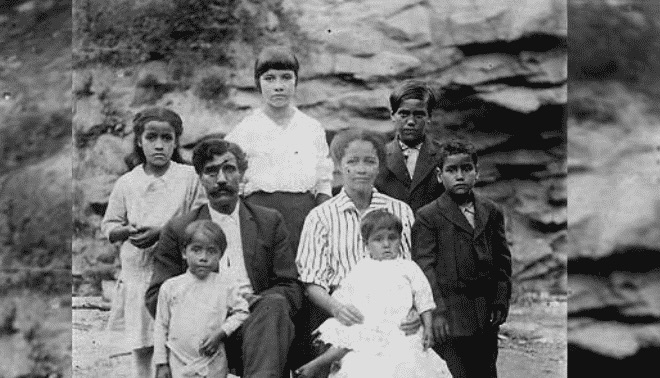
Melungeon people had some particular physical characteristics. They had dark hair and skin with light-colored eyes. There were wide variations in appearance among family members. They had a bump on the back of their head, right above the neck, called the “Melungeon bump.”
As laws were put into place that forbade the mixing of races, the people known as the Melungeons had no choice but to inter-marry. After the results of the Melungeon DNA project were published, many were upset as their families had claimed Portuguese or Turkish ancestry for generations. Most thought Melungeons had some Native American characteristics, but the Melungeon DNA project found very little mixing with Native Americans.
The Melungeons faced extreme discrimination wherever they went. There are very few people of mixed race descent in most of the Appalachian region. It is a region primarily composed of white people of Scottish-English-Irish descent. People with a darker skin stand out and face discrimination. The Melungeons also had particular surnames that identified them. Some of those names were Gibson or Gipson, Nichols, and Colllins, among others.
I can speak first hand about the discrimination the Melungeon people faced. One side of my family came from Magoffin County, Ky. I can remember my grandmother cautioning the grandchildren “not to be like the Gipsons.” We did not know who or what “the Gipsons” were. We only knew that they were a family whose behavior was considered somehow “dirty” and we were not supposed to emulate it. This is the type of discrimination these people faced. In order to fit in with the general population, the Melungeons self-identified as white mixed with Native American. According to the results of the Melungeon DNA project, the females were primarily of white, Northern European descent and males were mixed African and white descent. There was very little Native American found in the Melungeon DNA project.
The current state of many of the Melungeons is that they have intermarried and moved out of their home areas and intermingled with the majority groups in society. Many people in and out of Appalachia are curious about the Melungeons and whether or not they could have Melungeon blood. They use services like Ancestry.com to try to locate any possible Melungeon ancestors. #Melungeon #amwriting #amblogging #Appalachia #writing #Melungeons #MelungeonDNAProject #Appalachia