Posted in Non-fiction

With No Memory: A Story of PTSD

It was so frustrating. Liz got up every morning, sometimes at 4-5 a.m. Sometimes at 7 a.m. It didn’t matter the time. She never slept more than three or four hours a night. Still, she managed to function normally. This had been going on since she had been a graduate student. She blamed graduate school. Liz and her fellow students had stayed up late night after night studying, often at her dining room table. Then, she woke up only a few hours later to go to work. She thought she had developed this bad sleeping habit then. Thirty years ago.

There were brief periods during the thirty years when she did sleep somewhat normally, but thinking back, she couldn’t isolate them. She only knew of one. After her divorce, but that was short-lived.

The problem? Liz talked to her doctor. She talked to more than one doctor but that was before the days when sleep studies were popular. Before the days when doctors got specialties in sleep disorders. Liza knew this could not be a healthy lifestyle but she didn’t know what to do without a doctor’s help. She tried to sleep. Her brain just wouldn’t shut off.

There was something else. Liz had recurring nightmares. They were worse than nightmares. She had heard them called night terrors. Her nightmares were so terribly severe she imagined she must be having night terrors instead of nightmares. She had the same night terror every night and it woke her every morning. She could make no sense of it. She always remembered it. Recently, a second night terror had been added to Liz’s repertoire. It was more horrifying than the first. Still, Liz went on with her life. Reasonably normally.

As Liz got older, the sleep deprivation and night terrors started affecting her more and more. It became harder to concentrate during the day. She seemed to be able to nap, although briefly, during the day, but her sleeping problem was just as bad at night. She started having other physical problems. One was a problem with her shoulders. A painful orthopedic problem. Her orthopedist gave her a mild painkiller. Not a narcotic. Just something mild. It helped with the pain.

Liz began to notice she was sleeping even worse than usual. She could trace the decline in her sleep back to when she started taking the painkiller. She had to go off the drug. Apparently, she was having the opposite reaction to it that it was supposed to cause.

Liz was starting to feel desperation. She was showing increased symptoms of sleep deprivation. She was falling asleep at inappropriate times. She was increasing irritable and was showing poor judgment. Her performance was not what it used to be. At about this time, Liz heard of a doctor who had joined the neurologists in the practice in which her own neurologist practiced. This new neurologist had three specialties. He specialized in neurology, psychiatry, and sleep disorders. Liz made an appointment to see him.

This new neurologist had her file from thirty years past. He walked into the examining room the day of her appointment. He said he had spent hours examining the plethora of information contained in her file. He knew, without further ado, what her problem was. Liz practically jumped for joy. If he knew the problem, they could fix it. Couldn’t they?

He diagnosed her with Post Traumatic Stress Disorder (PTSD). He was absolutely sure of his diagnosis based on her medical records. Liz sat back in her chair. Of course, she knew about PTSD. So many of the veterans from Iraq and Afghanistan were coming home with it. But, wasn’t PTSD an ailment of war veterans? What would have caused it in her?

The doctor asked her if she had any trauma in her life. Of course she had. Hadn’t everyone? He explained that some people reacted to it differently than others. He also explained that there may have been trauma that she could not remember on a conscious level which would explain the nightmares. Often, only one traumatic event, if it is bad enough can trigger PTSD. Often, people have more than one event in their lives. Liz could remember perhaps two events that met what she thought were traumatic enough to cause PTSD. She could remember one of them distinctly. The other was back in her childhood and she had only vague memories.

Liz’s doctor said he suspected there were memories she was repressing. He told her that those memories would be hard to tap into and he suggested, at first, they try to deal with the sleeping problem. He prescribed medication. After they conquered that, they would decide what to do about repressed memories. He based his opinion on the fact that Liz could not remember large parts of her childhood and teenage years. There were even blocks of years as an adult she had blocked out.

For a few months, the sleep medications worked wonderfully. As time went on, they worked less well, until now, they weren’t working at all. Back were the sleepless nights and the night terrors even when taking the medications. Liz was not young anymore and this was bothering her more than ever.


This is only part of the story of an unlikely woman who has Post-Traumatic Stress Syndrome (PTSD). It is prevalent among veterans, but not exclusive to veterans. Many people who have PTSD don’t know they have it and never know why. If you have some of the symptoms mentioned in this story, seek help from your doctor. Keep on seeking help until someone helps you. Stay tuned for the story of Liz.


Posted in Non-fiction

Replacement

One of the promises that President Donald Trump made during his campaign was to address the failing infrastructure in the U.S. That is a campaign promise that everyone, Democrats and Republicans alike, can get behind. His current travel ban on certain groups from certain countries is now a new policy that is not amenable to a high percentage of the population of the U.S., even some of his own supporters.

My suggestion is that he practice a replacement strategy and focus on policies that can be supported by a majority of the American people such as the infrastructure policy. Mr. Trump has very low initial ratings as a President. Focusing on the infrastructure policy, as opposed to this travel ban on groups from other countries, would endear him to the American public. Everyone knows that the infrastructure must be addressed.

Even though Mr. Trump is signing executive orders on issue after issue, there are many of them that Congress has to address before they can before law. Mr. Trump just seems to be flailing around, not listening to his advisers, and perhaps not telling the truth to the American people regarding the travel ban. It has been reported that Mr. Trump conferred with Rudy Guiliani concerning the “Muslim ban” before he put the travel ban in place. This does not start his Presidency out on a positive note. Instead, he has to deal with people demonstrating in almost every airport across the country.

Mr. Trump chose seven countries for his travel ban. Interestingly, he did not put three countries on the list that were involved in the 9/11 attacks and he has business interests in all three countries.

There are questions. Has Mr. Trump violated the Constitution with his travel ban and refusing to allow immigrants into the country? At the very least, this travel ban is unAmerican. The Statue of Liberty has the following quote carved on it:

“Give me your tired, your poor, your huddled masses yearning to breathe free.”


Posted in Non-fiction

The Mongrel

img_0437

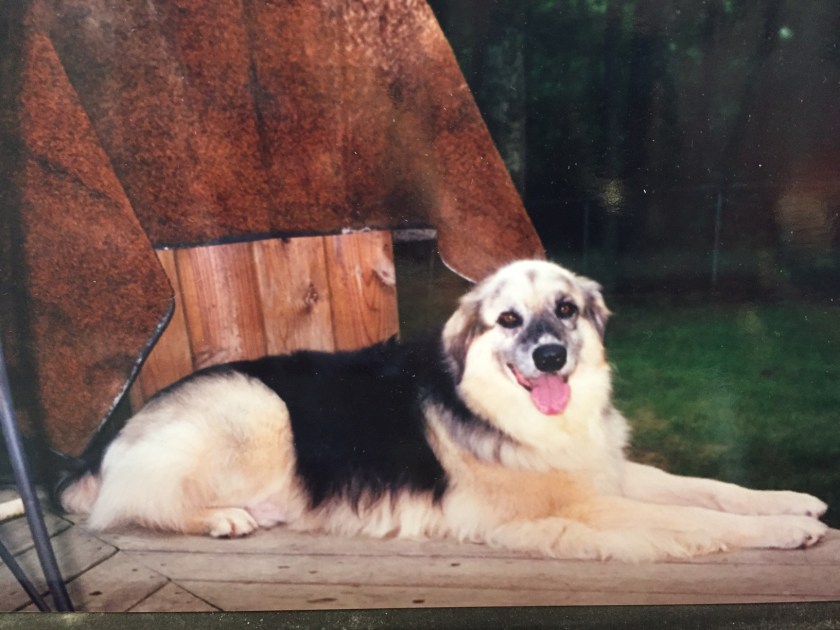
I already had the most wonderful dog, Eliza, a Cardigan Welsh Corgi. She was my baby, my friend, my protector. One Saturday, I went to the pet store to stock up on supplies for Eliza. Saturday is the day the pet store invites the Humane Society in, and some of their rescued dogs and cats, in case any of the patrons want to adopt a pet. If I’m there on a Saturday, of course I have to see the dogs. I am a dog lover.

As I was walking down the aisle of rescued dogs, I came to a large cage. Lying in that cage was a large dog with the saddest eyes I’d ever seen, and I’ve seen a lot of sad eyes.  Something about those eyes stopped me in my tracks. I leaned down in front of the cage and there was a big dog, obviously a collie/shepherd mix. Immediately, a name jumped into my head – Murphy. I have no idea where that name came from. I sat there and talked to him for a while. He didn’t really respond. He just looked at me. There was just something about that dog. But, when I got up to leave, he looked up at me and whined. Everything in me told me to take this dog home with me.

I found one of the Humane Society workers and asked them about the dog. He was a stray they had picked up. He was hard to capture, very afraid. He acted like he had been hurt or abused. He was a biter. They were afraid he was vicious and were not sure they should even have him there for that reason. Something in my heart told me he would not be vicious with me or Eliza.

I left the pet store. I had to think. I ran some other errands. The Humane Society worker told me they thought he was an older dog. So did I. There was something about that dog that was pulling at me. He needed a home for his last years on earth. I thought he needed my home and my care. He needed Eliza as his friend. But I had never had a large dog and I lived alone.

I went back to the pet store and set up the adoption process. I was going to adopt him or at least give it a try. I just had a strong feeling it would work out. The Humane Society was going to neuter him. I could pick him up in two days. I bought a big, cushy bed for him, healthy food, a toy and chew bone, and then I went to tell him he was coming home with me. Maybe I was imagining things, but he stood up in his crate and seemed to brighten up.

Two days later, I went to pick up Murphy, his new name. I had also bought a new collar and leash for him. We walked out to the car. He was very good but didn’t understand cars. I taught him to jump in the back of my SUV. We had a 70 miles trip home. Murphy never made a sound.

We got home. I guess the rest is history. He and Eliza got along famously. I had to housebreak Murphy, but it only took one time. He lived in the house with Eliza and I and spent lots of time on his new bed, which he seemed to love. I don’t think he’d ever been in a house. He was the sweetest dog to me and became my protector. He loved my girlfriends, but he hated men. I had to be very cautious when any man was around because he would have attacked them. Obviously, someone had hurt him. During the entire time Murphy lived, that never changed though I tried.

Murphy was healthy. My vet thought he was at least eight years old which is getting on in age for a large dog. Eliza and I loved Murphy for three years. During those years, Murphy developed hip dysplasia. He had the beginnings of it when he came to us. Finally, he couldn’t get up anymore without great pain even though he was on medication. At about 11 years of age, I had to have Murphy sent to the Rainbow Bridge, but I was gratified. His last three years had been wonderful. It was apparent he never forgot the first eight years of his life, but I could always tell he was so appreciative of his last three years.

I loved that big dog. He loved hugs so much. Was Murphy a mongrel? Not in any negative connotation. He was a mixed breed but he was my Murphy and one of the most wonderful dogs I’ve ever had.

img_0425

Click to purchase at amazon.com

Posted in Non-fiction, Travel

Update on Whales: Prisoners for Entertainment

img_0436

A few months ago, I wrote a blog post on orca whales, who are actually dolphins, and the problems they face in captivity, and Tilikum, the whale featured in the movie Blackfish. Blackfish is the movie that publicized the plight of the orca whales that are kept in captivity. The movie finally forced entertainment facilities like Sea World to stop using the orcas for entertainment purposes. They also stopped breeding them in captivity.

Tilikum recently passed away at the age of 36. He died from a persistent bacterial lung infection. Tilikum finally became aggressive in captivity and, in 2010, he killed a trainer at Sea World. He was implicated in the deaths of two others. There was actually sympathy for Tilikum because the stress of his captivity was seen as the major factor in his behavior. There have been reports of oracas trying to commit suicide in captivity as reported in the above-mentioned blog post.

After Tilikum died, the President of the Humane Society, was quoted as saying that his death meant the end of the orca captivity program. We can only hope. A much better alternative for us is to take whale-watching tours a few miles out into the ocean. RIP Tilikum

Posted in Non-fiction

Can our Democracy Last?

image

John Adams, one of our founders feared that it could not when he said, “Remember, democracy never lasts long. It soon wastes, exhausts, and murders itself. There never was a democracy yet that did not commit suicide.” Of course, that was a long time ago and they were just in the process of building America, our great shining city on the hill.

We are not a true democracy but a representational democracy. If we were a true or pure democracy, all laws would be made by direct, popular vote. Some of our laws are made like this. Most are not with a good example being the electoral college.

Our founders actually seemed to prefer a republic to a democracy. They are identical in every aspect except one. In a democracy, power is held by the group. In a republic, power is held by every individual. Most think the United States is a mixture of the two forms of government.

The ancient Greeks, in the 4th and 5th centuries BCE, formed an amazing democracy for a time. Ancient Athens gave its citizens equal political rights regardless of descent, social standing, wealth, and other factors, though women could not be involved. The democracy devolved into an oligarchy after a defeat in war. An oligarchy is a government ruled by a small group of people, sometimes private citizens, who exert an inordinate influence on the government. Sound familiar? Athens did influence forms of government for two millennia.

Athens is just one example of a democracy devolving into a more tyrannical type of government. The Roman Empire was a republic upon which the U.S. government was partially based. It, too, ended due to a number of factors. The Roman Empire found itself in a severe financial crisis. The causes were years of war and overspending and high taxes along with inflation caused a widening gap between the rich and poor. The economy started to decline. The Roman Empire lasted much longer than the average of 200 years.

Other examples of the failure of democracies and republics exist. The characteristics of the demise all seem to be similar. Greed, power, money, and a concentration of power at the top lead to the fall of such forms of government. What about the United States of America? Is it too late for us to reverse the course of history?

What do you think?

Posted in Non-fiction

Life With a Warning Label


img_0428

Have you ever noticed that everything you do and every aspect of your life seems to have some sort of warning attached to it? There seems to be something hazardous about everything we do and someone seems inclined to warn us about it.

Warning! Wear Your Seat Belt Under Penalty of Fines

That’s one of the first ones I can remember that actually made me mad. Of course, I wear my seat belt but never without feeling a little bit rebellious.

There are more good warnings, I think, than bad ones. For example, we all value weather warnings. There is some sort of extreme weather just about anywhere you live. So we need tornado, hurricane, earthquake, cyclone, severe storm, flood, and more weather warnings.

Medication is another good warning. We don’t want to take medicine that might interact with other medicine.

There are workplace warnings. Warnings if you take too much sick leave or are late getting to work. There are performance warnings and other conduct warnings.

There are warning lights and symbols all over the dashboard of your car. I don’t even pretend to know what most of them mean.

There are so many other warnings systems that I can’t begin to name them all.

Which warnings or groups of warnings either aggravate you or are warnings that you think are good things?  Mention them in the comments! #blogging #JusJotJan3/17

img_0425

Posted in Non-fiction

Discover What You Need

img_0413

No matter how old or young we are, we constantly discover things we need, and don’t need, in our lives. I have been slowly discovering, over a period of time, what I need. But I only just came to a decision regarding what to do about it. Sometimes, discoveries are difficult, even painful. My discovery about what I need to do with my life isn’t painful, but it is going to be rather difficult even though on many levels, it’s exciting.

My decision. I have to move. Change my residence. Have a new place to live. Have some new experiences. When I say that I have discovered I have to move, I don’t just mean to the next town, I mean 1000 miles away. South. Near the ocean and where the weather is always warm. Margaritaville. Paradise. I guess that gives you a clue.

I moved from the city to the country 18 years ago. I grew up in the country, right in the area to which I moved. I moved because of my career. It’s true what they say. You can’t go home again. I haven’t been happy since I moved back to the country. I guess I unknowingly became a city girl in the 25 years I was away. When you move away from your hometown just 2 1/2 years after high school and stay gone for 25 years except to show up there for your job and drive back to the city to go home each day, you lose touch. You lose touch with the people and the culture. You lose touch with your friends that still live in your hometown. You lose touch with the culture they live in. You become different over the years and so do they. My hometown, where I worked but didn’t live, became different right under my nose. I’ve been lonely since I moved back to the country.

I’ve thought about just moving back to the city, but now I’ve changed and it doesn’t suit me anymore. I have good friends there but things like the climate don’t suit me. I need things now that weren’t so important to me in the past. Warm weather. The ocean. A smaller city with close access to a big city. People my own age with interests similar to mine. Because of the type of career I had, I have friends all over the country. College professors are transient by nature. I’d like to live in a college community.

I need to be close to the conveniences of life. I’m not now and I have to drive a 150 mile round trip to the city to take advantage of those conveniences. Sometimes, I drive to the city three times each week. Often, it is two times per week. I’m tired. I’m tired of that drive and living on the interstate. What I consider necessary conveniences for me may not be necessary for you. What I do know for sure is that the time is coming where the drive is going to be very hard for me. I want to be able to walk out my front door and have a good restaurant within a mile or two instead of 75 miles. I want to expend the energy I use for that drive on other fun things. Like sitting on the beach.

Imagine this. For 23 years, I’ve commuted several times a week, one way or the other. I can’t imagine how many years of my life I’ve expended on that interstate!

It was not an easy decision for me to move 1000 miles from home. I like to put down roots. Completely pulling up stakes and leaving everything familiar to me scares me to death. A wise person once said to me that you should do what scares you. That’s where growth lies. I believe that.

I’m lucky. I still work but I can do what I do from anywhere since I am a writer/consultant.

Soon, we will start house-hunting in the area where we want to live.. Then, in the spring, we will put my house up for sale and hope we can somehow simultaneously sell the house and buy another in Paradise.

It’s scary. Wish me luck! Go out and get what YOU need! #amwriting #amblogging #writing

Posted in Non-fiction

Travel: Mystical Matlacha


img_0385

Ivy had worked hard all summer and fall. She was a writer and had been working on the first draft of her first novel. A first novel is hard enough. The first draft is a killer. Ivy was ready for a break before she started editing. Writer’s don’t have much money and Ivy was no exception, but she did sell some of her writing so she had some cash to burn. She decided to take her break in one of her favorite places.  Mystical       Matlacha, Florida. A funky little Old Florida fishing village on the little bit of land between mainland Florida at Ft. Myers/Cape Coral and Pine Island, one of the barrier islands in the Gulf. Pine Island is immediately north of Sanibel Island.

Matlacha is definitely off the beaten path. It’s near Cape Coral and Ft. Myers but the road to it runs toward the Gulf Coast and Pine Island. The population hovers around 750 citizens, plus or minus. It is actually one of three islands – Matlacha, Little Pine Island, and Pine Island. Matlacha is the mystical, magical, whimsical one of the three. Ivy felt like she needed a Matlacha fix before she embarked on editing the first draft of her novel. She had loaded up a couple of weeks worth of clothes, her bicycle, and her friend, Shelby, and they had driven from their home in Tennessee. A long drive but worth it. Shelby loved Matlacha as much as Ivy did.

The minute they saw The Bridge, they both got excited.

“Look, Ivy, there’s The Bridge,” cried Shelby..

“Oh my God, Shelby,” “It’s still under construction,” Ivy said, as they maneuvered their truck through the very narrow lane across The Bridge. The Bridge in Matlacha is called “the fishingest bridge in the world.” Day and night, there were always dozens of people fishing off that bridge.

Ivy was tired and just wanted to find their bed and breakfast in the small town. They were staying at Bridgewater Inn. Ivy had stayed there before and she loved the porch that wrapped around the small inn. It was the perfect place to relax and watch the dolphins, manatees, and tarpon. Deep-sea fishing is one of the pastimes in Matlacha. Ivy had plans to fish for tarpon one day while Shelby shopped.

Ivy and Shelby got checked in the Bridgewater Inn and went to the porch to relax and shake off the road dust and noise.

Ivy asked Shelby, “Do you remember the first time we were here and went fishing for tarpon?”

“Oh yes,” said Shelby. “I had never heard of a fish called a tarpon before we came here that first time. Then we went fishing and the damn thing almost capsized our boat!”

Tarpon are huge game fish prized by fishermen but they aren’t very good to eat. Their habits are interesting as they come to the surface to take big gulps of air. They can weigh up to about 280 pounds. The area around Matlacha is prime tarpon hunting waters.

“It’s a good thing we had fishermen with us that knew what they were doing or we would have ended up in the Gulf with the tarpon,” Ivy said, and they both laughed.

After they had their fill of the warm breeze and view of the calm bay surrounding Matlacha, Ivy and Shelby decided to take a walk down the mile-long main street that runs through Matlacha. Not only did they want to walk, but they also wanted to find a place for dinner as they were hungry after a long day of driving.

They first passed the Doll Lady’s house. In her yard, there are hobby horses and dolls that sit in metal chairs. It looks like a whimsical shop should be inside, but there is no shop. There is a sign on the door announcing this. It is a private home and the Doll Lady is just entertaining the tourists.

They pass a number of gift shops. Many are rather high-end gift shops where souvenirs that have an ocean theme can be found. They aren’t junk but pieces of art. There are a number of fine art galleries showcasing local artists work and some showcasing the work of well-known artists. Much of the work is for sale and would look fine in your home. You will also find Trader’s Hitching Post which sells fine silver and turquoise jewelry. There are, of course, the requisite tee-shirt shops, but most shops have goods that are higher quality and higher prices. Most of the shops and buildings in Matlacha are painted in pastel colors so typical of Old Florida.

“There is Bert’s Bar and Grill,” said Shelby. Both women had been looking forward to stopping by Bert’s to eat. Bert’s is an interesting place. You’ll know it by all the Harley’s parked at the curb and the pool tables in the front of the Bar and Grill. If you walk past the pool tables, you get to the restaurant.

Ivy and Shelby sat down and were immediately spotted by a server. They both ordered a grouper sandwich platter, the requisite order at Bert’s, at least the first time you stop by on a visit to Matlacha.

Ivy said, “I have been dreaming about having a grouper sandwich here. Bert’s has the best grouper I’ve ever tasted.” Shelby concurred.

After eating, Ivy and Shelby walked back to their bed and breakfast and got ready for bed. It had been a long drive and they were ready to turn in for the night.

There are other excellent restaurants in Matlacha. There is Sandy Hook’s Fish and Rib House which serves excellent fish and other entrees along with Moretti’s Seafood Restaurant on the water. For dessert, there is a wonderful ice cream shop near The Bridge. There are usually vendors all along the road through Matlacha selling various types of fish if you are staying in a place where you can cook.

There are also other lodgings besides the Bridgewater Inn. Check out Knoll’s Court Motel and Matlacha Island Cottages. Most of all, enjoy this fascinating island whether you fish or shop or sit and watch the dolphins like Ivy and Shelby. It will do your soul good. #Florida #amblogging


Posted in Non-fiction

The Standing Rock Pipeline Resistance

img_0376

This issue had been resolved, but today, January 23, 2017, President Donald J. Trump issued an Executive Order stating that this Pipeline would go forward.

The Native American Standing Rock Pipeline Resistance is based on two issues. The construction of the pipeline will cause sacred sites to be bulldozed. The pipeline will also be constructed under the Native American’s source of water and they are legitimately concerned about leaks. The resistance is entering its eighth month.

The resistance is organized in the Sacred Stone Camp by the Standing Rock Sioux Nation. The news media says that the resistance is unprecedented but Native Americans have organized protests and more than one resistance down through the years. Our news media just does not give the Native American the news coverage it should. We have treaties with the Native American tribes that we seem to conveniently forget when we want to. Many of those treaties have to do with just this type of land infringement.

In 2015, the Rosebud Sioux organized a protest against the Keystone XL pipeline which would have crossed their land, calling it an act of war.

Disregard for the rights of the Native American, the indigenous people of America, is not a new issue. Protests such as the one at Standing Rock have happened down through the years. The U.S. government has a history of disregard for the Native American lands and for our own indigenous people themselves.

Perhaps the most famous resistance was the one that happened at Wounded Knee in 1973. Wounded Knee was the site of the massacre of hundreds of Native Americans in 1890. Protests since then have resembled the one at Wounded Knee including the Standing Rock protest.

The United Nations has called out the United States over the treatment of our indigenous people. We have used violence against them including things such as rubber bullets, tear gas, and compression grenades. They are simply protecting their rights under their treaties with us. The U.N. statement also mentioned cultural rights, free speech, and the environment.

We should take notice that the U.N. is involved. If we can’t honor the treaties between the U.S. government and our own indigenous people, how can we be trusted to honor the treaties with foreign nations? #amwriting #amblogging #writing #StandingRock

Posted in Non-fiction

Thanksgiving – Yesterday and Today

img_0340

The United States has just been through a very divisive Presidential election. It seems the entire country is polarized. Friends have argued with friends and, in fact, friendships and even family relationships have been lost over the election. What we need at this Thanksgiving holiday season is to think about the meaning of the first real Thanksgiving in our country.

In 1621, the Plymouth colonists and the Wampanoag Native Americans shared an autumn harvest feast that they called a thanksgiving for the successful harvest. There were also other successful harvest feasts. All were full of the wonderful,
aromatic food from the fall harvests. The key was that the English colonists and the Native Americans shared the food in peace.

It couldn’t have been easy for either group. The English colonists were running from the tyranny of an English King. The Native Americans must have felt like their homeland was being invaded. But, they put aside their differences and shared the bounty of the fall harvest. The American people, many of whom are so galvanized on one side of the political spectrum or the other that they hardly talk to their family and friends who have different opinions, need to consider the actions of these two very different groups on that Thanksgiving so long ago.

On this first Thanksgiving, the story is that the Native Americans came bearing deer for venison. The feast also probably included duck or goose instead of turkey. They were close to the sea so lobster, clams or mussels may have been on the menu. Squash, carrots, and peas may have been the vegetables. The only corn in November would have been dried corn. Nuts like walnuts and chestnuts may have been available. If there were any sweets, it would have been only pumpkin as the colonists sugar supplies had run low during the trip from England.

They had an excellent Thanksgiviing dinner though different from what we traditionally have now. But they had it together, these two very diverse groups with different opinions and goals. I hope they can be an example for the rest of us this Thanksgiving. #amwriting #amblogging #writing #Thanksgiving #dailyprompt