Posted in Appalachia, Climate Change, Creative Nonfiction Essays, Lifestyle, Uncategorized, weekendcoffeeshare

A Thought on Extended Families

I know a woman who has a large extended family. Let’s call her Pat. Pat’s immediate family is gone. She was an only child who had no children. Her husband is still living. Pat has a large, but dwindling, extended family on her father’s side that she grew up with. They were all always close. Until one of Pat’s aunts passed away. Then, the family basically fell apart. The aunt was the glue that held them together.

The relationships within this extended family have gotten complicated. It makes Pat sad. She loved her extended family, particularly her cousins. But, I’m getting ahead of myself. I feel sorry for Pat. She assumed, for her entire life, that she could always depend on her extended family. Now she knows there are a few that she can depend on, but most of them don’t care about her anymore.

There were seven aunts and uncles in this family. All had one or more children. Pat’s cousins. The brothers and sisters were all close even though there were occasional squabbles. They saw each other frequently. That meant the children, Pat’s cousins, saw each other and were also close. Right or wrong, since Pat was an only child, she saw those cousins as her siblings. The older cousins were mentors. The younger cousins were her loves. She felt like they were her’s.

Everyone, of course, grew up and went on to live their lives. Of course, everything changed. Pat didn’t understand why their relationships with each other had to change. Just like in any family, there were quarrels. Everyone seemed to hold grudges instead of working it out. Emotional distances grew between the cousins. But not between all the cousins. Pat remained close to a cherished few of her cousins. Those cousins are the ones who live far away.

There is one aunt who is left in Pat’s family and she is treasured. Besides the one aunt,  there are 17 cousins, including several first cousins, once removed. Pat loves them all. There are two cousins that Pat has no contact with for reasons she doesn’t know. That leaves 15 cousins. Out of those 15, Pat thinks there are about five she could depend on in a crisis. Earlier in her life, she felt she could depend on just about all of them. Worse yet, Pat misses her cousins.

Take my poll. How do you feel about your extended family? The poll is anonymous. #amwriting #writing #blogging #family

Posted in Healthy eating, Lifestyle, Uncategorized, Women's Issues

Baby Boomers: Obsessed with Staying Young?

image

I may do a series of articles on the topic of baby boomers. I am one. I’m interested in the characteristics of all generations, but I’ll start with the boomers. Are we baby boomers obsessed with staying young? Baby boomers, in the U.S. were born between 1946 and 1964. The post World War II generation. There are many characteristics and issues I could blog about regarding we baby boomers but, in this post, I’m going to write about whether or not we have an obsession with youth. Are baby boomers obsessed with staying young?

Right away, I will tell you how I feel so you will know my particular bias. My answer is an unqualified yes. Of course, not every member of a group have the same characteristics so there are undoubtedly many boomers out there who are growing old gracefully. I just don’t happen to be one of them. I don’t think the majority of boomers are growing old gracefully. I intend to fight growing old – kicking and screaming if necessary. Yes, I know that, ultimately, it won’t help. But, I can try. I can take care of myself from a physical, mental, and emotional standpoint. I can do all I can do.

I contend that doing all you can do to take care of yourself and, yes, even fighting to stay young is not only an exercise in self-preservation but a positive outlook on life. Is it such a bad thing to want to look, think, and feel as young as possible? I don’t think so. I think many baby boomers would agree with me. Even doctors agree with me.  They say that people with a positive, young outlook and those who actively try to stay healthy, mentally and physically, tend to live longer and stay healthier

There are billions of dollars spent every year on anti-aging products and treatments. Since the baby boomers started getting older, the segment of the market offering anti-aging products and services has taken a huge jump and is expected to skyrocket by 2019. Not only do many of us not want to quit work, we also don’t want to get old, however you define old. We use treatments and potions on our faces and bodies. We get tucks here and there. We get shots of Botox and other fillers in our faces. We take our Vitamin D and stay out of the sun. We get facials, waxes, implants, dental work, and full-fledged face lifts when necessary. It isn’t your grandmother’s generation. I don’t see anything wrong with any of it.

What don’t we do? The very things that would make a difference. We don’t eat right, at least not as well as we should, and we don’t exercise as much as we should. Both can and do slow aging. There are pathways in our biology that can be used to manipulate aging. For example, the simple act of fasting can slow down the aging process. Short periods of fasting work. Intermittent fasting, or longer periods of fasting, work even better. Other techniques to slow the aging process can be learned from the people of Okinawa. They eat very lightly and only certain foods. They do practice fasting. Fasting shuts down growth and metabolism pathways.These people  live to be considerably over 100 years old and work into their 90s. The books written about their way of life are fascinating

Even for boomers who eat well, the downfall for many of us boomers is exercise. Exercise is an elixir for we who want to delay aging. We just choose not to drink it as often as we should. Exercise changes the way our genes work.

The good news is that there are ways to delay aging. When we reach late middle age, things start happening. Medical conditions happen. Some we can get under control. If we practice some of the techniques that science know work, we can delay the aging process. We can help that along, regarding physical appearance, with some of our treatments and potions. Of course, genetics plays a role. We have to start with the basics.

More to come on baby boomers and aging. Here is a link to one of the books on the people of Okinawa. It is fascinating reading. #amwriting #writing #blogging #BabyBoomers

The Okinawa Program: How the World’s Longest LIved People Achieve Everlasting Health and How You Can Too


Posted in Appalachia, Eastern Kentucky

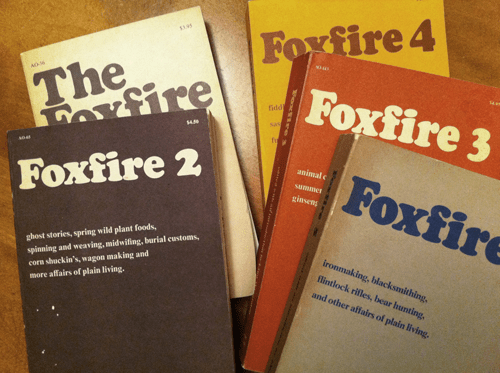
Appalachia: The Foxfire Books and Magazine


image

The Foxfire Magazine and the Foxfire series of books are some of the most fascinating works you will ever read on the culture and traditions of Appalachia. The Foxfire Magazine was started in 1966 in Rabun County, GA and was the result of a writing project by one of the teachers at Rabun Gap Nacoochee School in that county. The students were challenged by their teacher to interview local people about Appalachian customs and write an article about what they discovered. What happened was a phenomenon. The stories told to the students about different bits of Appalachian culture were so fascinating that by 1972 they were gathered together in book form and published. It became a bestseller and brought attention to the Appalachian region and the Foxfire project.

Before the books came the Foxfire magazine. It was a compilation of the stories told to the students assigned this project in Eliot Wigginton’s English class. This magazine has been in publication continuously since 1966. The name “foxfire” came from a naturally occurring bioluminescence in fungi in the mountains of North Georgia.

Gradually, there were so many stories about crafts, folklore, recipes, Appalachian history, and culture, that a series of books were developed. The first book was an immediate bestseller when it was published in 1972. Other books were published and the proceeds were used to develop the Foxfire Project. There are now eleven companion volumes to the original Foxfire book.

The Foxfire Project has been able to build an Appalachian Heritage Center in Georgia. It is the repository of material having to do with Appalachian culture and, of course, the Foxfire books and magazines. It also is a source of learning for teachers about experiential teaching and learning, which is what allowed the Foxfire Project to be born. Much later than 1966, experiential education became commonplace in high schools and colleges.

The Foxfire Project, books, and magazines are true Appalachian treasures. You can find how to subscribe to the magazine and donate to the project at FoxFire Project. You can find the fascinating Foxfire series of books wherever books are sold. #foxfire #amwriting #writing #blogging


Posted in Flash Fiction, Uncategorized

Breckinridge and the Reunion


imageTim and Skip looked at the picture fondly. They remembered the days of soccer at Breckinridge. After finding it, they were discussing a reunion of the soccer boys who were in their class.

“That’s Kenny and Scott,” Skip said. “Here is Clif and Reggie,” Tim added, “and Jerry and Peter.” The other two were them. “I think we can get all of us together,” Tim remarked. Of course, Scott would not be there. He had passed away a number of years ago. They divided up the names and agreed to make phone calls.

Breckinridge had closed many years ago and was now a university building. After they all connected, they agreed to meet at a local restaurant for dinner, drinks, and a lot of reminiscing.

The reunion was a great success. Everyone had gone their separate ways but coming back together, except for the missing one, helped keep them grounded and gave them strength.


*Photo courtesy of Yinglan

*FFfaw sponsored by Priceless Joy

Posted in Creative Nonfiction Essays, Politics

On Being Decisive And Donald Trump’s Use of “Maybe”

image

Are you a decisive person? Do you make up your mind about something and stick to it? Or is your favorite word “maybe?” I can tell you that this blogger has a definite dislike, perhaps hatred, for the word “maybe.”

Based on the 2016 Random House Dictionary, the word maybe means possibility or perhaps if used as an adverb; a possibility or uncertainty if used as a noun. Nothing decisive about any of that, is there?

How do you like it, dear readers, if you ask someone a question and their response is “maybe,” or “possibly,: or “it’s a possibiity.” Do you know any more than you did when you asked the question in the first place? No, you don’t. This blogger considers herself a fairly decisive person. I think I usually can evaluate a situation and make a decision fairly quickly. It’s not always the right decision, but it’s a decision nevertheless. I don’t think I leave people hanging with a “maybe” very often. Sometimes, I have to look at my calendar and I have to put someone off and give them a decision after I look at my calendar, but I try to carry my calendar with me so that won’t happen.

Donald Trump’s speeches are an example of the power of the negative power of the word “maybe.” Slate.com runs a column called Lexicon Valley on the power of language. The author, Andrew Kahn, analyzes Trump’s speeches and his powerful use of the word “maybe.” He categories Trump’s use of the word “maybe” by Levels. For example Trump’s Level I “maybe” happened when he was discussing President Obama’s birth certificate and he says something “Maybe It Says He’s a Muslim.” Of course, Trump doesn’t know that, but the word “maybe” plants just enough doubt in the minds of his supporters.

Kahn’s Level 2 “maybe,” is not premeditated like a Level 1. In referencing the Orlando shootings, Trump suggested that maybe President Obama was soft on terrorism. There are other examples. The Level 2 maybe shows uncertainly about what this candidate thinks and believes but fires up his supporters. That is his point.

Then there is the Level 3 maybe which Trump uses when he wants to portray modesty and humility. He says that his campaign and support is a phenomenon that has “maybe” never happened in history.

The word “maybe” can be powerful in a negative way as candidate Trump proves. He has used it masterfully. #realDonaldTrump #amwriting #writing #blogging #dailyprompt


http://www.slate.com/blogs/lexicon_valley/2016/06/22/donald_trump_uses_the_word_maybe_as_a_crutch_and_a_bludgeon.html


Posted in Blog Series

#2: Baby Boomers: Our Unhealthy Eating Habits

image

Sometimes, in the United States, I think the food industry is out to kill us. Scratch that. Not sometimes. All the time. Then again, I suppose they feed the people what the people want, what the people will buy, which is an even sadder statement on the American diet. This is one of many things the baby boom generation does wrong if it wants to keep itself young. We don’t eat right.

Here are a few interesting facts and figures. We eat around 2,775 calories per day. Only 205 of those calories are fruits and vegetables. About 600 of those calories are in a category called “added fats and oils.” Those are not found naturally in our food products. They are what is added to processed foods like crackers and other off-the-shelf products. Bread and other grain products, like rice and corn, are around 610 calories. We have increased our grain consumption 45% since 2000.

The lack of consumption of vegetables, particularly, and fruit has depleted our essential nutrients, compromised our immune systems, caused us to gain weight, and inhibited our digestion. Only 22% of adults report eating vegetables daily. In all but three states, the average servings of vegetables were less than 1.7 per day.

The wheat we eat today does not contain the minerals it once did. It is not as nutritious as it used to be which has led to a plethora of health problems including gluten intolerance, magnesium deficiency, and lack of absorption of calcium and zinc, among others.

The fats and oils category indicates that we have decreased our use of saturated fats but increased our use of hydrogenated fats and oils. We were told for years that saturated fats were bad for us. While we still should limit our intake, they are far healthier than hydrogenated fats. Eat real butter instead of margarine. Use olive oil on your salads. Instead of canola oil or sunflower, peanut or corn oil, use coconut oil to cook with.

Then there is salt. We average 3,400 mg per day. Twice the daily recommended amount and seven times more than our body needs. No wonder so many people have to take high blood pressure medication. Too much sodium may lead to stroke and heart attacks.

Maybe the worst statistic of all is this one. Of that 2,775 calories per day that we average, 25% comes from animal products, 12% from plant products, and a whopping 63% from processed food, sugars, hydrogenated fats, and oils.

We wonder why insurance costs and prescription drug costs are high. #amwriting #writing #blogging #HealthyLiving


Posted in Flash Fiction, Uncategorized, Writing

A Boy and his Horse

image

“Artie, I can’t believe you rode that horse up here to the revival meetin’,” Kaye said.  “Why not, Momma,” Artie replied, “Old Clara is good to ride.” Kaye said, “You didn’t even put a bridle on that old hag.” “Momma!” Artie cried, “Clara is not an old hag.” “Bah,” said Kaye. “You’ve embarrassed me in front of the preacher and all my friends.”

Out of the meetin’ tent flew Artie, as fast as his short legs would carry him. He swung himself up on Clara’s back. As they walked down the road, Artie searched the fields for the biggest haystack he could find. He parked Clara and himself right behind one.

After dark fell and Artie’s momma got home, he was still behind the haystack with Clara. “He’ll come home when he’s hungry or scared,” she said to her husband, and shut the door, turning out the lights. #flashfictionforaspiringwriters #writing

*Photo courtesy of Phylor

**FFfAW brought to you by Priceless Joy

Posted in Travel, Uncategorized

A Bucket List of Off-Beat Travel Destinations

image

Have you ever wished that you had a list of desirable travel sites — sites that you might like to travel to, sites you might like to put on your bucket list. That’s what I’m going to give you right now. These travel locations are based on my own travel experiences. Some may be locations you would expect. Some will not be on your radar but guaranteed by me. When you have the opportunity to travel, visit this list.

1. Brittany, France: Here is a travel location you probably would not expect. Brittany is the area of France in the far western part of the country. Tourists do go there but it is not as commercial as most of the rest of France. It is the peninsula in the western part of France bordered by the English Channel on the north, the Bay of Biscay on the South, and the Atlantic Ocean on the West. What makes Brittany so fascinating? One thing is that it is an important site for the King Arthur legend. You will find Merlin’s tomb and the castle associated with the Lady of the Lake, along with other Arthurian  legends. Brittany has much to offer. It was, to me, a cross between Britain and France with some Scots thrown in.

2. Portugal: Yes, the entire country and it is a country tourists forget about. A fascinating country! You have to spend some real time in Portugal to really enjoy it. One of the regions I especially enjoyed was where the cork trees grew. The Alentejo. It is lightly populated and has the largest cork forests in the world. Seeing the cork trees and learning how the cork is harvested is worth a visit. It makes up a large part of the land mass of Portugal. On the west is the Atlantic Ocean. To the east is Spain. The cork forests are mixed in with olive groves and wine estates. On the south are castles and, yes, you can stay in them for the night. When you drive through the villages, you feel as if you should be quiet. It is almost a spiritual experience. The cork trees are old. Centuries old. They keep shedding their bark and regenerating. Move on then to other Portuguese regions. You will be glad you did.

3. Negril, Jamaica: Ah, the beach, but what a beach! It is an insult to compare Negril to most other beaches. Miles of beautiful white sand and Negril is not a particularly heavily visited beach. It’s hard to reach. You can get there by a relatively expensive flight from Montego Bay, Jamaica. As far as driving there from other ports in Jamaica, forget about it. You can get there, but the roads are terrible. Negril is a very laid back, international destination with great bars and restaurants. Reggae fills the nights. Water sports and sun fills the days. Try the breadfruit for breakfast. #amwriting #writing #blogging #travel #France #Jamaica #Portugal

Posted in Creative Nonfiction Essays, Lifestyle

The Peter Pan Syndrome

image

We all know who Peter Pan is in children’s literature. He is the little boy who never grows up, who can fly and lives on the island of Neverland, leading his band of Lost Boys. His friends are fairies, elves, and the occasional normal child. He just wants to have fun. Psychology being what it is, there is a syndrome named after Peter Pan, the Peter Pan Complex or Syndrome. Young males, up into their 20s or 30s, are sometimes diagnosed with it. Yes, you guessed it. They just want to have fun and someone along the way decided it was more complicated than that and that it was a mental illness.

Even more interesting is that there are also female Peter Pans. Yes, right again! Girls just want to have fun. They have been labeled as the female clones of the male Peter Pan’s. It is quite the stereotype to have the title of “Peter Pan” slapped on you whether you are male or female.

When male children are labeled “Peter Pan,” their parents typically try to break them from such atypical behavior. They insist that they “grow up.” Psychologists say that such children refuse to accept responsibility, to keep promises, to commit to anything, and show excessive concern about the way they look. Much of the literature says the children are the victims of overprotective parents. I say that there is much ado about nothing. Why not give these kids some breathing room? Let them grow up in their own time. What, indeed, is the definition of “growing up?” Does it mean that we can’t have fun anymore? That we, like Peter Pan, are criticized for being young at heart?

The body of literature goes ahead to say that the males who exhibit the Peter Pan syndrome look for women who mother them, take care of them. That they don’t like to work, to keep steady jobs. That they, in effect, have too much fun and not enough gainful employment.

We live in a society long since descended from the Puritans. We know that the Puritans didn’t much believe in fun for the sake of fun. Could the basis of this “syndrome” have come from jealousy that these young people could indeed have fun without feeling guilty about not working all the time? Were we put on the earth to work all the time? I guess you see I have more questions than answers.

Here’s where it gets more interesting. What about the female Peter Pans? In doing some reading for this article, I got increasingly furious. Female Peter Pans like to talk to their girlfriends, compare hair and makeup and skinny jeans and think the world revolves around them. How many of us women, no matter what age, enjoy such entertainments? Could I safely say many of us? I don’t think we all think the world revolves around us. In fact, most of us help run the world with pretty responsible careers and family obligations.

Female Peter Pans are supposedly afraid of commitment and are easily bored. Bored? Who has time to be bored? Commitment? With spouses, partners, and children. You’ve got to be kidding me. But, put this together with wanting to connect with our friends and wear nice clothes and we suddenly turn into Peter Pan;. Sheesh.

Female Peter Pans supposedly live in places like lofts, or downtown, or…..Portland. They apparently aspire to be cool. Maybe they just like to live in those places. Sounds nice to me.

Last, but certainly not least, female Peter Pans think they are immortal. Yes, I have actually read that. I don’t believe that for a minute. But perhaps they would like to live  their lives, have fun, and not spent every minute thinking about their own mortality.

To be frank, I think this is a bunch of crap. People who exhibit Peter Pan-like traits tend to be young at heart and most of them have careers and take care of themselves just fine. I’ve always been Peter Pan-ish and have had a professional career and a relationship with my extended family. I have a number of friends who also have a little Peter Pan going on. But, I don’t think we are going to run off, live in a loft in Portland, and quit our careers, not to mention decide we’re immortal.

Don’t believe everything you read! #amwriting #writing #blogging #PeterPan #FairyTales



Posted in Lifestyle, Uncategorized

Apologize Much?

Girl with Sorry sign

Do you extend an apology to everyone you meet for your every questionable word or action? There seem to be two kinds of people. The first, a Type I person, is the type I just described. They apologize for everything. Every possible misdeed. Every word that could possibly offend any one in the room. Even those words or actions that do not offend anyone. This type of person is insecure and feels the need to counter their words and actions with an attached apology.

The second type of person never apologizes for anything, or almost never. They go through life saying what they want and doing what they want. They feel entitled, often at the expense of other people’s feelings. If you get an apology from a Type II person, that person must feel they did or something really bad. This type of person is often angry right under the surface and refuses to give anyone the satisfaction of their apology.

Psychologists have found that if a person apologizes too frequently, it becomes background noise and no one really takes them seriously. Especially in close relationships, the timing of the apology is important. If you have committed some sort of transgression for which you feel you need to apologize, only do it after the person that you want to apologize to has had the opportunity to vent their feelings. Only then will your apology seem sincere to them.

Studies have found that there are gender issues associated with apologies. Men apologize less frequently than do women because they have a higher tolerance for issues about which they might need to apologize. They also apologize to women far more than they do to other men.

Apologize when you have really offended someone but don’t throw around offhand apologies or people won’t take you seriously. But, do make sure you have the ability to see when you are wrong or have offended someone and make your apology. Sincere apologies help retain relationships and simply make our society a more civilized place in which to live. #amwriting #writing #blogging #lifestyle