Posted in Uncategorized, weekendcoffeeshare

#weekendcoffeeshare: 6/4/2016

image

“She is still the epitome of class,” Jenn said as she walked into my kitchen for our #weekendcoffeeshare. I had no idea who she was speaking of so I waited. “Mae,” she stated. I searched my memory and quickly remembered who she meant. I had just known one Mae in my life who fit that description. I asked if she had seen her this week. I thought Mae was quite sick. She was at least 20 years older than us. “Yes,”she said. “I saw her briefly. She was with her son.”

As we sat down to share our coffee, my mind drifted to an earlier place and time. Mae is a distant relative. A relative by marriage. She was a cousin of a dear departed uncle and I was uneasy for any news of her. I had always admired her.

Jenn commented that Mae seemed reasonably well considering her age and infirmities. She had known her and they had a nice chat about events in the present. They also reminisced a bit about the past. Jenn said that Mae seemed happy, though limited in how much she can get around.

“She seemed sensible at first,” Jenn said. “So much like the Mae we knew and loved. Her son warned me that her mind was not as good as it used to be but when we started to talk and she knew who I was, I doubted him.”

“Then she dropped the bomb.”

My ears perked up at that statement. Knowing Mae as I did, I knew she was a soft-spoken, Southern lady. I couldn’t imagine her dropping any bomb. I hadn’t seen Mae in a long time, but she was always a gracious lady who tried to make everyone as comfortable as possible. Mae drops a bomb? She would never do anything shocking or controversial. I was sure Jenn was overreacting.

She looked at me as she said, “Mae said she had murdered a child she had by a man who was not her husband.”

Mae is the face of dementia. This is what the victims and loved ones of people with dementia live with every day. Flashes of the person they had known and loved. Then shocking statements and behavior they were convinced their loved ones could never have thought of or perpetrated. Mae had not murdered anyone. Her son told Jenn that she lived in a fantasy world more every day. Her fantasies didn’t seem to bother her. They surely bothered everyone else.

Mae’s son quietly told Jenn that environmental factors, such as television, seemed to set off her fantasies. She would take scenes from television shows and think she was one of the characters except it would be real to her. She would even imagine that she was physically inside the TV. It had become so bad that they had to leave it turned off most of the time.

Mae had to have someone with her all the time. She had been a wonderful cook during her life and she would go into the kitchen, turn on the stove, and put something inappropriate on a plate, like paper. They had to put out more than one kitchen fire due to this. Mae could not be left alone for any length of time.

Dementia is a living nightmare for those suffering from it. We also have to remember the caregivers. For those caring for loved ones with severe dementia, they literally watch their family members disappear. Not only is caring for a loved one with dementia emotionally demanding, it is physically draining since they require constant care. At some point in the illness, families need help either in the form of outside caregivers or institutional involvement.

Jenn and I finished our morning coffee and continued chatting about Mae for a few minutes. It was worrying to both of us to think of her and her family and what they were facing. As Jenn left to go on with her day, I thanked her for filling me in, but I’ve thought of little else but the beautiful, classy Mae I once knew and the terrible illness called dementia. #amwriting #writing #blogging #bloggersrequired #dementia

*weekendcoffeeshare is sponsored by Parttime Monster

Posted in Appalachia, Eastern Kentucky

Book Review: Clay’s Quilt

Clay Sizemore, a young coal miner who lost his mother at a young age, is the main character of Clay’s Quilt. This novel by Silas House, a renowned Kentucky author, was House’s debut novel in 2001. I’m reviewing this book for you because it is one of the best novels I have ever read. It is worth reading whether you are interested in Appalachia or if you are just interested in reading a good novel. If you like a heart-wrenching story, populated by colorful characters, and set in the most difficult of environments, you will enjoy Clay’s Quilt.

The story is a microcosm of life in Appalachia based on this one Eastern Kentucky family but it will strike a familiar chord to members of all Eastern Kentucky families. I know this writer, at times, felt like I was reading about my own family.

Free Creek, the setting for the novel, is located in the hills of Eastern Kentucky, near coal mining operations. Young men like Clay Sizemore and his friend, Cake, are born here and never expect, or want, to leave. They settle into their occupations, raise a family, have a big extended family full of aunts and uncles and nieces and nephews, and this is their life. It can be a very good life. It can also be a hard life, but these people, the people of Appalachia, don’t know that. This is all they know and they wouldn’t have it any other way.

Clay Sizemore lost his mother in a tragic car accident when he was three years old. That day, an icy and snowy winter day, Clay’s mother decided she was going to leave her husband. She took Clay with her and lost her life on slick roads. His extended family closed ranks around him and raised him from the age of three. After that day, Clay never knew his father. He had his beloved Aunt Easter, who took care of him as a boy. He also had Uncle Paul, who made quilts, and Dreama, his cousin who he loved like a sister.

Clay became a hard-working coal miner. He worked in the mines during the day, but on the weekends, he and Cake went to the local honky-tonk, drank their fill, and listened to their mountain music. There he met the beautiful Alma, a fiddler with whom he wanted a future, but Alma had her own problems. Most importantly, Clay had a box of his mother’s possessions from which he tries to put together her past, hoping to figure out who she was and who he is. During this time, Uncle Paul is making a quilt – out of the pieces of Clay’s mother’s clothes.

This is a beautiful story written by Silas House in lyrical prose. It is short on sentimentality and long on descriptive characterizations and good storytelling. It is easily readable in a weekend. Clay’s Quilt is a stunning and mystical novel that will stay with you for a long time after you read it.

You can get the Kindle edition at amazon.com or the hardcover or paperback at Abe Book’s. Enjoy! #writing #am writing #blogging #appalachia #Best_Books

Posted in education, Funding, Higher Education, The Economy

Cutting Funds for Education: A Declining Future for America

image

It seems fashionable these days to say that not everyone needs a college education. Actually, that’s true. We need people with vocational training — electricians, plumbers, auto mechanics. We need people with specialty training – jewelers and clockmakers. But, we also need college educated people to do research, to teach, to help run our businesses, to be chemists and biologists and anthropologists and financial analysts. It is also fashionable, it seems, to cut the funding for institutions of higher education to the bone and the programs and people right along with them.

Let’s focus on higher education. I was a college professor for 27 years so I do have a bit of insider information and understanding. What happens when funding is cut for a state university? First, tuition goes up for the students. That is one of the primary sources of funds for universities. Of course, there is always fundraising from donors to the university but that money is far less certain than tuition increases. Every time there is a funding cut, if you have college-age children, the money it takes to run the university comes right out of your pocket.

What actually happens inside the university with funding cuts? In the state in which I live, state universities are experiencing funding cuts. The university where I taught had to eliminate some faculty and staff positions. Some were vacant. Some had actual people teaching and serving as support staff in them. There goes the unemployment rate – up. Academic and sports programs were eliminated. There were times when we were under a budget crunch at my university that we had a hard time scrounging up paper and pens, let alone the newest technology. Do you know what happens to faculty and staff morale when that happens? It starts a downward spiral. How effective do you think the faculty are at teaching your children under those circumstances? I can tell you – not very effective. The faculty and staff are worried about losing their jobs and they don’t really have the materials they need to do their jobs. Your children suffer when there are funding cuts to higher education.

Cutting higher education funding is a short-term strategy for state legislatures to use in order to save money. Some think supporting higher education is not a good strategy for stimulating economic growth. Some think that a better strategy for economic growth is enacting tax cuts for the wealthy or for large corporations while raising money by cutting higher education funding. That is a very short-term view. In the long-term, allocating money to reduce tuition and student debt and improve graduation rates would benefit the economy more. There seems to be a disconnect in the minds of our legislators between the value of college-educated young people and what they contribute to our economic growth. Unfortunately, we seem to have entered a period of time in our society in America when we can’t see the forest for the trees. We can’t see that we diminish our future if we don’t invest in education — all education. After all, people clapped and cheered when one of the Presidential candidates this year said that he loved the poorly educated.

So what’s the answer to states looking for money? It seems obvious! Cut something else. Don’t cut education. Education is the future. Education is not only your children’s future, it is our country’s future. Cut the legislators’ travel budgets. Or their expense accounts. I just bet I could find a number of non-essential line items if I went through the state budget and I bet you could too. Cutting education seems to fly in the face of good reason. In fact, it is not only a short-term solution, it is selfish. Would the legislators who vote to cut education rather satisfy their lobbyists, and reap those benefits, than adequately educate their children and contribute to the future of America? Right now, the answer appears to be yes. Let’s elect some legislators who will answer a resounding NO to that question. #amwriting #writing #blogging #bloggersrequired #GdnHigherEd

*Image acquired from Stuart Miles at FreeDigitalPhotos.net


Posted in Non-fiction

The Deer on my Porch

image

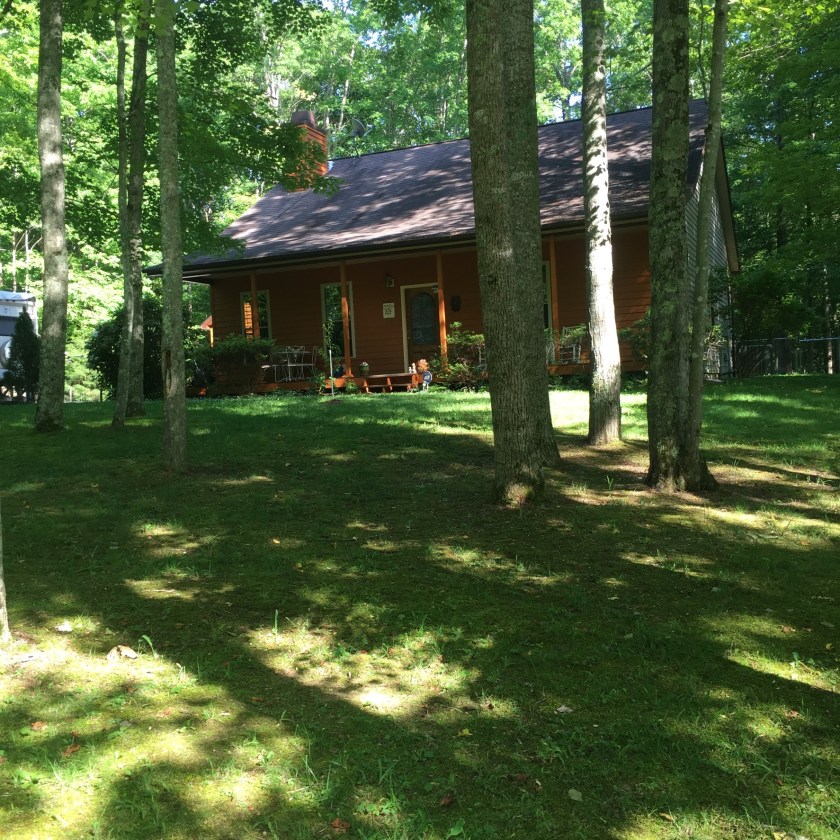
When I first moved to my home, 18 years ago now, I lived on a gravel, country road in a rural county in my state and my house was the only occupied house on the road. Life had been tough for me over the preceding few years and I needed to retreat, regroup, heal. I was also moving closer to my work after many long years of commuting. I loved it here. After being a city girl for 25 years, it was a restful sanctuary. My little cabin in the woods.

You see, I live right in the middle of the forest. Or I did. That part of the story comes later. There are still lots of very tall, probably second or third growth trees, mostly hardwood, around me. This area is known as “the hardwood capital of the world.” It is green, very green, dense, and beautiful. Most of all, it was private. I needed private. Most days, it seemed there was only me — and the wildlife. Beautiful birds. butterfly’s, one species which only lives on the particular mountain where I reside. Lots of whitetail deer.

My state is considered the number one state, at least by many hunting websites, in which to hunt whitetail deer. I’m not a hunter so that is mildly disturbing to me. I do understand, however, the need to reduce the herd from time to time. As far as the population of the whitetail deer is concerned, this state is always in the top ten.

In the early days of my residence at my home, you could certainly tell that was true. I saw deer every day, a thrill for me. At first, they were skittish. I got the feeling they felt like I was encroaching, which, of course, I was. It is, after all, their land. So I bought some deer corn, cheap in those days, and put it out on the ground. They came to eat their corn and acted only mildly suspicious of me as I peered at them out the window. As time passed, I learned to tell the difference between the does and the bucks and learned that the little fawns showed up for their deer corn around June. The deer learned they were safe here and came every morning and evening. I made their deer feeding station a little more friendly for them. I added a real feeding trough, made by my cousin-in-law, and a salt block. I think the deer felt right at home. So did I. One of the highlights of my day was watching them.

That was then and this is now. I don’t have quite as many deer at the feeding trough as I used to. More houses have been built on the now-paved county road which means more people, more cars, but the deer still come. Until today. Today, I found out that the lot that adjoins my lot, right by their feeding trough, is going to be stripped of its trees and a house is going to be built 15 feet from my property line and right next to their food. When that happens, I will lose my deer. My friends for 18 years.

To me, this is a sign. It is time to move on if this happens. If that house is indeed built,  it may be time for this writer to find another sanctuary. The quiet will be gone. The deer will be gone. All the things I moved here for will be gone. It would be masochistic to stay.

So, I will wait a bit and determine if that offending house is going to be built. If so, I may start looking for yet another sanctuary. Writer’s need a retreat. The next one probably won’t be in the woods and there probably won’t be deer. But, I intend to find a special one.

Oh yes. The title of this post. “The Deer on the Porch.” One morning I was getting ready for work and I heard someone (I thought) clopping around on my front porch. I went to see who was at the door. It was a whole host of deer, walking around on my porch and one of them was peering in the glass!

They call the development of lots in a subdivision, even a rural one like mine, “progress.” Is it progress? It doesn’t feel like progress to me tonight. It feels like possibly having to leave home and leave my friends behind. It feels like I am at the mercy of a ruthless land developer who cares nothing about people or places or wildlife or life in general, but just money. It feels like that particular ruthless developer, when he chose the lot on which he was going to build, knew I would value my privacy enough to consider buying the lot from him rather than letting him build and he is price-gouging me. In coarser language, it’s called extortion.

This writer is a survivor and I have survived worse. This particular ruthless developer built my own house and I spent lots of money and time getting it fixed due to shoddy workmanship and the fact he didn’t pay all the subcontractors and walked off the job before it was completed. Not everything is fixed….even after 18 years. So, I have issues  with this particular ruthless developer. If he continues his planned project on the lot next door and without giving me adequate time to raise the cash I need to buy the lot or negotiating a reasonable offer, then I will have more issues with the ruthless developer. The house he will build will likely have workmanship as shoddy as my house did, before it was repaired. I wonder if anyone will buy it?

I am not going to be at the mercy of anyone, even a ruthless land developer. Just remember. There is always something you can do to help your circumstances. And I am going to do it. Progress? Perhaps I can keep my sanctuary here on the road in the woods and won’t have to look for another one. I hope my deer on the porch will remain on the porch. Stay tuned!

*Image copyright 2016 Rosemary Carlson

Posted in Appalachia, Eastern Kentucky, Food, Holidays, Memorial Day, Recipes, Uncategorized

Recipe for Memorial Day: Corn Pudding

image.jpeg

Just for fun, I want to share with you an old-fashioned Eastern Kentucky recipe that you might enjoy for your Decoration Day celebration. It came to me from my aunt, Sylvia Prater, who was born and raised in Appalachia. She was my mother’s sister, a wonderful cook, and our whole family enjoyed her big meals often as I was growing up and even after I became an adult. Here is her recipe:

Corn Pudding

Preheat your oven to 350 degrees.

Combine the following ingredients in a 13″ by 9″ baking dish:

2 cups frozen corn

4 beaten eggs (I recommend a cage-free brand)

2 cups milk  (I recommend skim milk)

2 tbsp butter (i recommend real butter like Kerry Gold)

1/4 cup sugar

Salt and pepper to taste

Grease your baking dish with a dab of the butter. Bake at 350 degrees for 45-60 minutes. Stir before it sets. Enjoy for your holiday dinner! #am writing #writing #blogging #appalachia #recipes

*Image courtesy of ji1991 https://freedigitalphotos.net


Posted in Appalachia, Eastern Kentucky, Holidays, Memorial Day, weekendcoffeeshare

#weekendcoffeeshare: 5/28/2016

image

Hello! I didn’t know if you would come by for coffee since it is Memorial Day Weekend, but I’m glad you did! It is such a beautiful day. Why don’t we sit out on the front porch at the table and we can have our morning beverages? Here….help me carry the pots. Thanks!

Tell me what you’re doing this holiday weekend? Oh, you are going to your family home in Floyd County! That county is right next to the county where my mother’s family came from. Are you taking flowers and going to a family cemetery? Yes, I know. My family cemetery is on top of a hill too. Also a private cemetery. So many of my ancestors are buried on top of one hill or another in Magoffin County in private cemeteries. The family all chips in every year to keep them maintained. So do you? That’s just the way in Eastern Kentucky, isn’t it? Very few of my relatives are buried in the public cemeteries in the area. Oh, you call Memorial Day Decoration Day, do you? So many people do in Appalachia. There is a whole story behind Decoration Day.

Memorial Day was originated as Decoration Day in 1868. It was established by the Grand Army of the Republic, the Union Veterans of the Civil War, to honor all the Civil War dead. An earlier Memorial Day, in 1866, was celebrated by women of the Confederacy in Columbus, Mississippi.

Memorial Day, or Decoration Day was celebrated on May 30 no matter what day of the week that date fell on. The families of the war dead usually celebrated the holiday by placing flowers on their graves. Gradually, Decoration Day included all war dead, not just Civil War dead. In 1971, Decoration Day, then called Memorial Day was designated a national holiday and was to be celebrated the last Monday of May.

In Appalachia and in most of the South, the tradition of the holiday did not change. It is still called Decoration Day and still celebrated on the Sunday before the last Monday of May. It’s an important holiday in Appalachia. Relatives of the war dead come home to the region from far-flung places to place flowers on the graves of their relatives and to see relatives still living in the area. It is a tradition that the cemeteries are cleaned and mowed, graves are cleaned up and weeds are cut, and everything is made to look nice for the holiday. All types of flowers are placed upon the graves from live to cut, artificial, and silk. Flags are placed on the graves of veterans. Usually, a big meal is eaten at some relative’s home and a lot of visiting takes place. In Eastern Kentucky, at least, relatives are buried in private cemeteries all around and through a county, or several counties. A lot of driving and walking up hills to private cemeteries is required.   You can’t even get a car up to where this writer’s grandparents and great-grandparents are buried.

Church services are often conducted in the local churches on Decoration Day. Some families celebrate it as a secular holiday. It seems that one of Americans’ favorite events on Memorial Day is attending one of the parades in thousands of cities and towns.

I’ve enjoyed having coffee with you today! I hope you enjoy Memorial Day!

*Image provided by Simon Howden #freedigitalphotos.net

**Thanks to parttimemonster.com for providing the linkup for #weekendcoffeeshare!


Posted in Appalachia, Eastern Kentucky, history

The Early Homes of the Appalachian Mountain People

image


Friday Fare to Appalachia

Caves. Rock ledge overhangs. Primitive cabins. In that order. That is where the mountain people of Kentucky settled after they made the difficult trip to what would become the Commonwealth. As the people came into Kentucky through the Cumberland Gap — from North Carolina and across the mountains from Virginia, they experienced a really arduous journey. The trip across the mountains from North Carolina and from western Virginia was treacherous and extremely physically taxing. As of 1782, about 4,000 pioneers had settled in Kentucky and they were the ones who had made this exhausting trek. By 1790, there were 40,000 settlers in Kentucky and the increase in settlers had largely found their way to Kentucky via the Ohio River. Kentucky was settled by the people from Virginia, North Carolina, Maryland, and Pennsylvania, in that order.

As the pioneers made their way over the mountains to the south and east, they most likely lived in cave-like structures along the way, when they could find caves not inhabited by the black bear. When they arrived in Kentucky, caves were their first living quarters and they made them quite sophisticated on the inside (photo, top left). After caves, the settlers moved to rockhouses. Rockhouses were under cliff overhangs and were held up with poles, a technique probably borrowed from the Cherokees. You can find locations where rockhouses existed even today, one in Magoffin County, KY near this writer’s family home. But, it wasn’t long until the log cabin came along.

A lingering question is where did log cabin architecture come from? It didn’t come from the Native Americans since they did not have the axe as a tool until they got it from the white settlers. It probably did not come from the predominant nationalities of settlers, the Scots, Irish, or English, because those countries are mostly treeless. Many agree that settlers from Sweden, Switzerland, and southern Germany brought the idea of log cabin architecture to America and it made its way from where they originally settled in Pennsylvania to the Kentucky mountains. There was a small German population in Kentucky.

There is some confusion about where log construction came from, however. The word “cabin” is Irish. The log cabin’s construction seemed to be Irish based on the fact there were openings under the eaves instead of gables. Log cabins came before log houses on the frontier. The log houses were probably based on Germanic construction techniques and even included houses with the dog trot plans seem so frequently in Eastern Kentucky. Both were lumped together and called cabins, however.

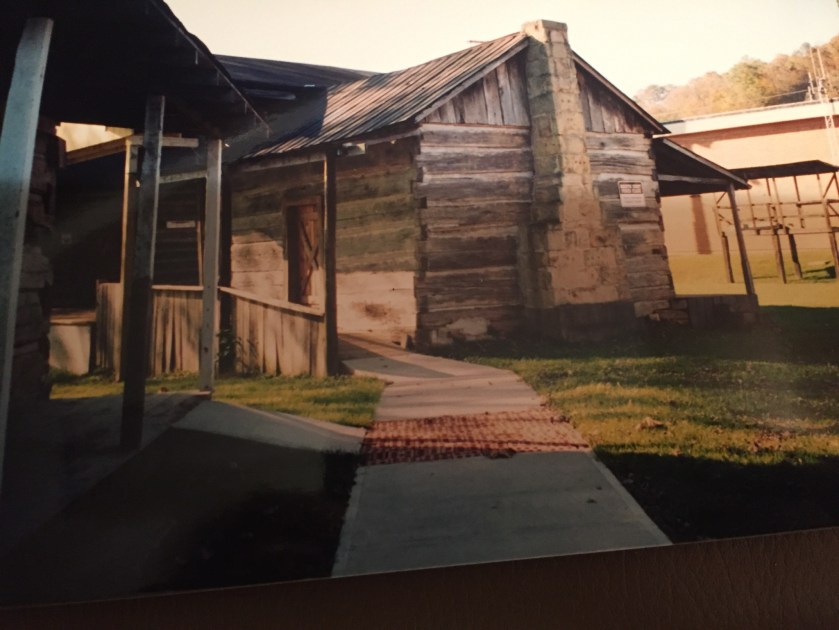
Cabins were more crudely constructed than houses. Cabins were built quickly from logs notched at the ends, chinked and daubed, or sealed with stones and mud, with chimneys made of sticks, rocks, and mud, and they usually had no windows and a dirt floor. The roof was made of bark. Houses were more carefully built. They had windows and floors and chimneys made of stone. Their roofs were wooden shingles.

This essay describes the progression of housing only in Eastern Kentucky during the late 18th century and very early 19th century. Some parts of Appalachia were more progressive and, by the early 19th century, had moved to frame houses. Those were available only to the wealthiest settlers.

*Note: The photo of the log cabin above was taken by this writer. It is located in a display park around the Magoffin County Historical Society in Salyersville, KY. It is an actual cabin, taken from the county, and rebuilt for display in the historical society’s park. This writer’s great-grandparents built and lived in a cabin very much like this one and raised their five children. Copyright 2016. All rights reserved. #amwriting #writing #blogging #history #appalachia

Posted in Appalachia, Eastern Kentucky

Introducing A Regular Blog Feature: Friday Fare to Appalachia

image

Hi everyone! Beginning this Friday, 5/27/2016, I will introduce a regular Friday feature on my blog, Writings from the Heart, called Friday Fare to Appalachia.

Every Friday, you can look forward to a story about Appalachia. An essay, an article, a personal story, Appalachian recipes, old ghost stories, folk tales, music, or some manner of information about Appalachia and Eastern Kentucky. I’ll write about Appalachia other days of the week too, but you can depend on it on every Friday.

I hope you will join me for fun on Friday Fare to Appalachia!

Rosemary


Posted in Eating Disorders, Food, Healthy eating, Weight Loss

Eating Disorders: Orthorexia

Eating disorders. This isn’t really about eating disorders but everything you read about something called “orthorexia” will make you think you are reading about an eating disorder. As I was doing some research for this article, I originally thought I really had a bone to pick with this guy by the name of Steven Bratman. OK, Dr. Steven Bratman, which doesn’t impress me all that much given that he coined the term orthorexia. I did more research, I decided that his original article had been taken completely out of context in most everything that has been written about orthorexia since so maybe he wasn’t such a bad guy after all.

After all, even though he is an American Medical Association (AMA) qualified physician, he practices some forms of alternative medicine and he lived in a commune in the 1970s. He can’t be all bad, can he?

Back to orthorexia. We have the legitimate eating disorders such as anorexia and bulimia and a handful of other full-fledged eating disorders. If our society keeps putting pressure on our young women, there surely may be new varieties of eating disorders spring up. Orthorexia, as defined by Dr. Bratman, refers to a fixation on eating the proper food. (I can envision all my friends standing up, pointing their fingers at me, but they have surely forgotten about my love for tequila.) To continue, Bratman actually called it orthorexia nervosa, similar to anorexia nervous.

Anorexia and bulimia both focus on the quantity of food a person eats. Orthorexia focuses on the quality of the food. Bratman originally defined this eating disorder as one where a person may avoid all preservatives, fat, meat, and processed food. Orthorexics are vegetarians in that they do not eat dairy, eggs, or even fish. When Bratman considered himself to be orthorexic, he said he looked down on all his friends in the commune who didn’t eat exactly as he did and felt they were lesser human beings for their sins of eating foods such as meat or dairy or foods that were processed. Perhaps the most disturbing thing is this. Part of Bratman’s diet was to never fill his stomach more than half full when he ate a meal. He was never satisfied after eating.

No wonder he decided this was an eating disorder. The way Bratman handled so-called “healthy eating” wasn’t very healthy.

To say Bratman went overboard with his so-called healthy eating is an understatement. It was definitely not healthy mentally for him and it probably was not healthy physically. There was no mention of Bratman’s weight in his article so we don’t know if his eating habits caused him to lose an excessive amount of weight.

Bratman believed in using food as medicine when he started out on his health food journey. Unfortunately, he took it too far. In the years since he wrote his article in 1997, the medical community has learned that there are illnesses that do respond to changes in the diet. The term “health food” is not really used anymore. It has probably been replaced by organic food along with just the knowledge that items like processed food and too much red meat are not particularly good for us.

AMA-qualified doctors seldom address nutrition with their patients unless it is in the context of illnesses like lowering cholesterol. Then, they might tell you to lower your consumption of red meat. If you have high triglycerides, they will tell you to lower your consumption of sweets or carbohydrates. For a disease like diabetes, diet is definitely addressed. For a normal, healthy adult, however, nutrition is not something you usually are lucky enough to discuss with your family doctor. You have to seek out a dietician or even a doctor who specializes in alternative medicine, perhaps a nutritionist.

I have read other articles that mention orthorexia. The examples they give of individuals that have this particular eating disorder are usually also suffering from some form of obsessive-compulsive behavior or other Risk factors. There is nothing wrong with healthy eating. But, there is something wrong with anything you do if you do it in excess. A wise saying that all of us has heard. Everything in moderation.

Bratman, Steven. Health Food Junkie. Yoga Journal 1997; September/October:42-50.


Posted in Emotional Child Abuse

Emotional Child Abuse: Mother and Little Girl

image

In a previous post, I told you a story about a little girl I once knew. Although most of this ongoing story is about the little girl, I want to introduce you to Mother. Maybe a small part of Mother’s story can help explain how the little girl found herself in such a terrible predicament within her family. I’ll have to warn you. I’m not terribly sympathetic to Mother though I am trying to develop a little understanding.

When I came to know Mother, the little girl was five years old and Mother was 35. An older mother to a child that young back in those days, to be sure. Mother had tried for a long time to have a baby. She was almost 30 when she succeeded. Mother’s pregnancy was difficult. The little girl found out later that she bore the scars of that difficult pregnancy. So, probably, did Mother.

Mother visited the town’s only doctor a lot. He was an excellent doctor but only had the knowledge of those times. But, he was wise beyond those years. Mother had a number of physical ailments that she was diagnosed with when she was between 35-40. Those, however, did not start plaguing her until a few years later.

Mother’s problems during her late 30s were less of a physical nature and more of an emotional nature. Mother had a problem with Daddy. At that time, I didn’t know what  that problem was as I was only a friend. I do know that, as a few years passed, the problem seemed to grow more severe.

The problem with Daddy was not the only source of emotional distress for Mother. Mother had come from a background that was emotionally difficult. Her mother, Grandmother, was a high-strung, temperamental woman who was cold and not particularly loving. Grandmother, to be honest, was mean. Though Mother would never have said so, Mother grew up in a family where the parents were not demonstrative with any sort of loving behavior. Grandfather was a kind, generous man but probably not outwardly emotional. Mother may never have learned how to love. That is what the little girl told me when she became a grown-up woman. She also said that Mother, as she grew up, was much like Grandmother – mean, temperamental, and cold.

Here was Mother – problems with Daddy and a little girl who needed her. A raft of physical problems and an even bigger load of emotional ones that she probably did not understand. No one to help but an old family doctor who tried his best and a sister next door who also tried her best. No one seemed to know what to do. So they did what so many families do. They hid and denied the problem, except among themselves.

Mother only looked outward for help. She looked to Daddy, the doctor, her sister, and even little girl. She failed to look inward and she did not try to help herself. Perhaps she couldn’t. Perhaps her problems were too severe. There is no way to know. The grown-up woman little girl became told me that, before Mother died, her emotional problems had only gotten worse, not better.

But, back to the story. Little girl wasn’t very old when Mother realized something. She realized that little girl was a great deal like Daddy as her personality developed. Mother and Daddy had never resolved their problems and, in Mother’s eyes, the worst thing that could happen was for little girl to grow up and be anything like her Daddy. She was supposed to grow up and be like Mother and her family. Fate has a way of playing tricks on us and that was not happening.

Since Mother could only punish Daddy to a point, wasn’t little girl a good substitute? Wasn’t she just like her Daddy? Wasn’t she like his family and not like Mother’s? That’s what Mother told me. Not that little girl was a substitute, but how much she was disgusted by the way she was just like Daddy. It was years later, when little girl was a grown-up, that she told me this one day.

Not only was Mother a cold, temperamental and unemotional woman, but she had a child much like a man she had grown to hate. On top of this, she had emotional, even perhaps mental, problems and no real help available. When I look back, I realize this was a recipe for disaster for that family.

So began the problems for little girl. Emotional child abuse. A form of child abuse just as damaging as physical or sexual abuse. It just doesn’t leave bruises or any physical scars, though Mother engaged in physical abuse more than once. Emotional abuse involves degrading the child, making the child feel that he or she is not good enough, expecting the impossible of the child, not being affectionate toward the child, and much more. It is not usually obvious to people outside the immediate family. Often, they think the child is acting out when they react to the abuse. But, children who are victims of emotional abuse are not acting out. They are reacting to what amounts to betrayal by their parent.

Child abuse of any type is the ultimate betrayal between a child and the parent. Little girl suffered that betrayal at the hands of Mother even though there were reasons that Mother acted the way she did. There is no reason for child abuse.

Follow this blog for the continuing story of little girl. Continue reading “Emotional Child Abuse: Mother and Little Girl”