Posted in Wildlife

Whales: Prisoners for Entertainment

image

Killer whales. Orcas. Synonyms for a single species. Both refer to the whale that is in the news right now. The whale from Seaworld that beached itself on the Canary Islands in a water park pool. Her name is Morgan and she is a captive who swims around all day in a concrete pen that is a fraction of the size of the territory she actually requires. Whales beach themselves when they are sick or hurt….or to die.

Orcas are not whales, though they look like a whale and that is what they are called. They are the largest species of dolphin. They have huge brains. They exhibit intelligence similar to the dolphins with which we are familiar and eerily similar to humans. Many animal species can pass along skills to their young which are generic in nature. In other words, birds pass along migratory routes. Big cats pass on hunting skills. But whales and dolphins go a step further. They can learn as individuals and pass individual knowledge on to their young — just like humans. Imagine a creature that intelligent swimming around all day in a pen that is tiny to them. Imagine a human being in a bathtub. Having to do tricks.

Many orcas exhibit self-destructive behavior when kept in captivity. They do things like repetitively bob their heads upwards and down. They swim faster and faster in small circles. At the Miami Seaquarium, there used to be two orcas. Lolita and Hugo. It has been reasonably well established that Hugo committed suicide in 1980 by repeatedly ramming his head into the walls of his tank until he died. Do we know for certain it was suicide? They can’t talk, at least not to us. I guess we can’t know for sure. But, no other cause was found. Some say Morgan, the whale that is in the news, was also attempting suicide.

The movie, Blackfish, is a documentary about an orca whale named Tilikum who killed his trainer while held in captivity, first at Sealand, then at Seaworld. Theories abound that whales held in captivity suffer from some sort of severe psychological trauma.

Orca whales, in the wild, swim around 100 miles per day and have a complex society. They live in several types of pod structures, all of which contain several generations of family, including children, parents, and grandparents. Their need for social interaction is high. Their needs cannot be met when held in captivity.

If we want to see orcas, why can’t we take whale-watching tours and go to them instead of making them come to us. If they come to us, they have to endure a life of captivity for which they are not suited. Seaworld announced this year that they would hold no more whales in captivity. It’s about time. Other marine parks should follow suit.

UPDATE: JANUARY 2017
A few months ago, I wrote a blog post on orca whales (SEE ABOVE), who are actually dolphins, and the problems they face in captivity, and Tilikum, the whale featured in the movie Blackfish. Blackfish is the movie that publicized the plight of the orca whales that are kept in captivity. The movie finally forced entertainment facilities like Sea World to stop using the orcas for entertainment purposes. They also stopped breeding them in captivity.

Tilikum recently passed away at the age of 36. He died from a persistent bacterial lung infection. Tilikum finally became aggressive in captivity and, in 2010, he killed a trainer at Sea World. He was implicated in the deaths of two others. There was actually sympathy for Tilikum because the stress of his captivity was seen as the major factor in his behavior. There have been reports of oracas trying to commit suicide in captivity as reported in the above-mentioned blog post.

After Tilikum died, the President of the Humane Society, was quoted as saying that his death meant the end of the orca captivity program. We can only hope. A much better alternative for us is to take whale-watching tours a few miles out into the ocean. RIP Tilikum.

*Image by Christopher Michel 2009 Born Free

Posted in history, Uncategorized

The Song of Hiawatha

image

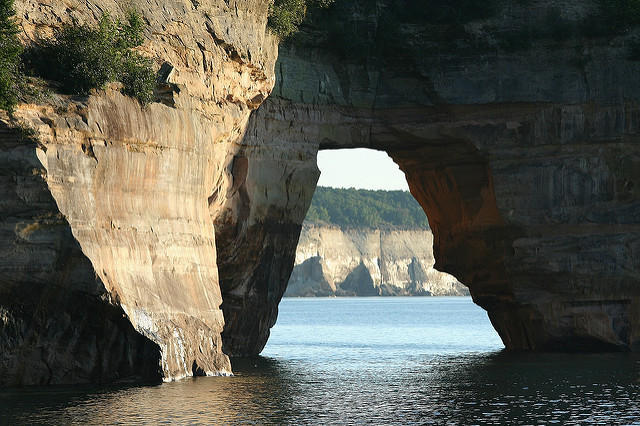
The Song of Hiawatha, by Henry Wadsworth Longfellow, was written in 1855 and set on the southern shore of Lake Superior, the largest of the five Great Lakes and the largest fresh water lake in North America. The poem is connected to the Pictured Rocks area of the lakeshore. Hiawatha, a Chippewa warrior, and Minehaha, his true love, played out a tragic love story in the beautiful poem on the Pictured Rocks Seashore.

The poem is also connected to Lake Superior because of one of the most famous lines in the poem……”by the shores of Gitche-Gumee, by the shining Big-Sea-Water…”. Gitche-Gumee was the Chippewa name for Lake Superior or the Big Sea Water.

Pictured Rocks Seashore is a beautiful place on an exquisite lake….a place I’ve visited many times since the ancestral home of my father is quite near the area and is itself near the shores of Gitche-Gumee.

Here is The Song of Hiawatha, compliments of YouTube:


*Image by Laurel Gillespie 2014

Posted in Diabetes, Low Carb, Weight Loss

My Life with Diabetes

image

There. I said it. Diabetes. Twenty years ago, I was diagnosed with diabetes. I have almost said it in a couple of blog posts, but never quite got up the nerve. I alluded to it in my posts on Healthy Eating and Orthorexia because I am always on a diet. Sometimes, a diabetic diet. Right now, both a diabetic and weight loss diet. Since I know many people can relate to this story, here goes.

When I was diagnosed with diabetes 20 years ago, I weighed 110 pounds. There is a misconception, I think, that you have to be overweight to develop diabetes. That is not true. I have diabetes on both sides of my family. Most of my aunts and uncles have diabetes and some of my cousins. The genetic cards were stacked against me. I remember coming home after the doctor gave me this news and announcing that diabetes was not going to change my life. I think back to that now and laugh. Maybe grimace is a better word.

I tried to control my blood sugar, at first, with diet and exercise. That is usually how doctors like to proceed. It very quickly became obvious that I needed more than diet and exercise. My elliptical and a strict diet just weren’t working. Diet for a diabetic, back then, meant no sweets and perhaps the old diabetic exchange system. Not much more. I went back to the doctor.

Next, we tried diet, exercise, and the drug metformin. The maximum dose. Metformin is a drug with a number of uses, but at this time, it was used primarily for lowering blood sugar in Type II diabetics. The beauty of metformin is that it also helps prevent negative cardiovascular events from occurring in Type II diabetics. We are at risk for heart events just by virtue of the fact we have Type II diabetes. Again, I stuck to my diet, rode the elliptical like a fiend, and took my metformin. My blood sugar did not come down. I felt like I would have to exercise on the elliptical for two hours after meals to make even a dent in my blood sugar.

Again, I returned to my primary care doctor. He decided that my particular case of diabetes was beyond his expertise and sent me to an endocrinologist. Endocrinologists specialize in diseases of the metabolic system such as diabetes and thyroid disorders. The endocrinologist was suspicious that maybe I did not have Type II diabetes after all. Maybe I had adult-onset juvenile diabetes or Type I diabetes. He did some tests for antibodies that indicate the presence of Type I diabetes, but they were negative. I had Type II diabetes, but I had very hard to control, brittle diabetes. The fear was that my high blood sugar was going to start causing damage to organs in my body so there was nothing to do but start on insulin, along with metformin and, of course, diet and exercise. By this time, most doctors were at least having their diabetic patients visit a dietician but except add “portion control” to the no sweets advice, not much had changed.

Type I diabetes occurs when the pancreas does not produce insulin and occurs primarily in children. It requires immediate insulin therapy. Type II diabetes is often seen in people who have insulin resistance. Their pancreas still produces insulin but, for whatever reason, their body cannot use it. In my case, I had been diagnosed as a Type II diabetic, which was the correct diagnosis, but I produced almost no insulin. It took several years before this was recognized by my doctors. When a Type II diabetic has to begin using insulin, they are then classified as a Type I diabetic.

Back in those days, insulin was still administered with a syringe and a vial of the drug. Those shots weren’t fun, but they did start to bring down my high blood sugar. My doctor specified the dose and it was very hard to get it right. Sometimes, the insulin was too little and my blood sugar would still go too high. The scarier times were nights, when my blood sugar went too low and I would wake in the middle of the night shaking, sweating, and have to stumble to the refrigerator to get a quick glass of orange juice to bring my blood sugar up. It often went too low at night.

I was still working during all those years. In fact, I worked for 15 more years as a college professor after I was diagnosed with diabetes. There were days when I felt good, like myself. There were other days where the fatigue, a side effect of diabetes, made going to the office almost more than I could do. I’m sure I would have taught longer had diabetes not struck. I am still working now as a writer, but I am retired from teaching.

Life got a little better regarding diabetes when the insulin delivery system changed from the traditional needle to a punch needle system. About the same time, carbohydrate counting became an option for controlling blood sugar and it seemed to suit my needs. You simply count the carbs you eat at each meal and take the appropriate amount of insulin for that amount of carbs, based on a formula supplied by your doctor. I was able to control my blood sugar better than ever as indicated by my A1c readings, around 7.0, along with my home monitor readings. Doctors were finally recognizing that “sweets” were just one carbohydrate and that all carbohydrates raised blood sugar. My endocrinologist was pleased.

Taking insulin is a mixed blessing. It saves a diabetic’s life. But, it makes you hungry. Diabetics have to watch what they eat, and how much, very carefully. Insulin, and the resulting hunger, cause weight gain and I gained some weight which caused poor blood sugar control once again. Taking insulin is a vicious circle. At this point in my life with diabetes, I was taking up to 90 units of Novolog insulin during the day and 60 units of Lantus insulin at night, along with a fairly new drug called Janumet. As any diabetic or doctor who is reading this knows, that is a lot of insulin. Janumet is a combination of metformin and sitagliptin. Sitagliptin is a bit more dangerous than metformin. It is more likely to cause low blood sugar and other side effects. It increases the amount of insulin a diabetic produces and decreases the amount of sugar produced by the liver. I knew I had to do something. I just wasn’t sure what and neither was my doctor. All that I knew was that I wanted to have a life. A normal, active life.

By this time, low carbohydrate diets had become popular. I did a lot of my own research, talked to my doctor, and decided to go on a low-carb diet to see if I could lose the extra weight I had gained and, as a result, lower my insulin requirements. That’s where you find this writer today. I am happy to report that it seems that a low-carb diet is working for me. My blood sugar control is the best it has been in 20 years. My weight is dropping and I am optimistic I can get to my goal. It isn’t far away now! I don’t even crave carbohydrate-rich foods any more. I live on lean protein and salad. I feel the best I have felt in many years and can, once again, have a normal life. When I reach my goal weight, I will allow myself some carbohydrates here and there, but not many. I have worked too hard for the success I’m enjoying. I’m not able to exercise much yet. Insulin makes that difficult, but since I take much less than I used to, I hope exercise is in my future.

The change in my insulin dose is remarkable. Most days, I take no daytime insulin at all. I don’t need it anymore. I still take 55 units of Lantus insulin at night. Since I don’t produce insulin myself, I will always need a maintenance dose at night. I also still take Janumet though that could change.

It wasn’t particularly easy to write this account of my struggle with diabetes. It’s very personal. I thought it would be cathartic for me and perhaps helpful to some of you. Helpful because you will know you aren’t alone. Helpful because maybe it gives you a place to start. But, don’t start anywhere until you talk to your doctor. Your mileage may vary though I would encourage you to do research on your own. Don’t be a victim of this terrible disease. Take charge of your diabetes. Don’t let it take charge of you. It works silently and will damage your heart, eyes, nerves, kidneys, blood vessels, and much more. Work with your doctor and find out what works for you. You will feel so much better and be able to live a long, happy life!

A great blog on Type II diabetes is Diabesity

I’ll keep you posted.

*Image by Stuart Miles FreeDigitalPhotos.net



Posted in Uncategorized, weekendcoffeeshare

#weekendcoffeeshare: 6/4/2016

image

“She is still the epitome of class,” Jenn said as she walked into my kitchen for our #weekendcoffeeshare. I had no idea who she was speaking of so I waited. “Mae,” she stated. I searched my memory and quickly remembered who she meant. I had just known one Mae in my life who fit that description. I asked if she had seen her this week. I thought Mae was quite sick. She was at least 20 years older than us. “Yes,”she said. “I saw her briefly. She was with her son.”

As we sat down to share our coffee, my mind drifted to an earlier place and time. Mae is a distant relative. A relative by marriage. She was a cousin of a dear departed uncle and I was uneasy for any news of her. I had always admired her.

Jenn commented that Mae seemed reasonably well considering her age and infirmities. She had known her and they had a nice chat about events in the present. They also reminisced a bit about the past. Jenn said that Mae seemed happy, though limited in how much she can get around.

“She seemed sensible at first,” Jenn said. “So much like the Mae we knew and loved. Her son warned me that her mind was not as good as it used to be but when we started to talk and she knew who I was, I doubted him.”

“Then she dropped the bomb.”

My ears perked up at that statement. Knowing Mae as I did, I knew she was a soft-spoken, Southern lady. I couldn’t imagine her dropping any bomb. I hadn’t seen Mae in a long time, but she was always a gracious lady who tried to make everyone as comfortable as possible. Mae drops a bomb? She would never do anything shocking or controversial. I was sure Jenn was overreacting.

She looked at me as she said, “Mae said she had murdered a child she had by a man who was not her husband.”

Mae is the face of dementia. This is what the victims and loved ones of people with dementia live with every day. Flashes of the person they had known and loved. Then shocking statements and behavior they were convinced their loved ones could never have thought of or perpetrated. Mae had not murdered anyone. Her son told Jenn that she lived in a fantasy world more every day. Her fantasies didn’t seem to bother her. They surely bothered everyone else.

Mae’s son quietly told Jenn that environmental factors, such as television, seemed to set off her fantasies. She would take scenes from television shows and think she was one of the characters except it would be real to her. She would even imagine that she was physically inside the TV. It had become so bad that they had to leave it turned off most of the time.

Mae had to have someone with her all the time. She had been a wonderful cook during her life and she would go into the kitchen, turn on the stove, and put something inappropriate on a plate, like paper. They had to put out more than one kitchen fire due to this. Mae could not be left alone for any length of time.

Dementia is a living nightmare for those suffering from it. We also have to remember the caregivers. For those caring for loved ones with severe dementia, they literally watch their family members disappear. Not only is caring for a loved one with dementia emotionally demanding, it is physically draining since they require constant care. At some point in the illness, families need help either in the form of outside caregivers or institutional involvement.

Jenn and I finished our morning coffee and continued chatting about Mae for a few minutes. It was worrying to both of us to think of her and her family and what they were facing. As Jenn left to go on with her day, I thanked her for filling me in, but I’ve thought of little else but the beautiful, classy Mae I once knew and the terrible illness called dementia. #amwriting #writing #blogging #bloggersrequired #dementia

*weekendcoffeeshare is sponsored by Parttime Monster

Posted in Appalachia, Eastern Kentucky

Book Review: Clay’s Quilt

Clay Sizemore, a young coal miner who lost his mother at a young age, is the main character of Clay’s Quilt. This novel by Silas House, a renowned Kentucky author, was House’s debut novel in 2001. I’m reviewing this book for you because it is one of the best novels I have ever read. It is worth reading whether you are interested in Appalachia or if you are just interested in reading a good novel. If you like a heart-wrenching story, populated by colorful characters, and set in the most difficult of environments, you will enjoy Clay’s Quilt.

The story is a microcosm of life in Appalachia based on this one Eastern Kentucky family but it will strike a familiar chord to members of all Eastern Kentucky families. I know this writer, at times, felt like I was reading about my own family.

Free Creek, the setting for the novel, is located in the hills of Eastern Kentucky, near coal mining operations. Young men like Clay Sizemore and his friend, Cake, are born here and never expect, or want, to leave. They settle into their occupations, raise a family, have a big extended family full of aunts and uncles and nieces and nephews, and this is their life. It can be a very good life. It can also be a hard life, but these people, the people of Appalachia, don’t know that. This is all they know and they wouldn’t have it any other way.

Clay Sizemore lost his mother in a tragic car accident when he was three years old. That day, an icy and snowy winter day, Clay’s mother decided she was going to leave her husband. She took Clay with her and lost her life on slick roads. His extended family closed ranks around him and raised him from the age of three. After that day, Clay never knew his father. He had his beloved Aunt Easter, who took care of him as a boy. He also had Uncle Paul, who made quilts, and Dreama, his cousin who he loved like a sister.

Clay became a hard-working coal miner. He worked in the mines during the day, but on the weekends, he and Cake went to the local honky-tonk, drank their fill, and listened to their mountain music. There he met the beautiful Alma, a fiddler with whom he wanted a future, but Alma had her own problems. Most importantly, Clay had a box of his mother’s possessions from which he tries to put together her past, hoping to figure out who she was and who he is. During this time, Uncle Paul is making a quilt – out of the pieces of Clay’s mother’s clothes.

This is a beautiful story written by Silas House in lyrical prose. It is short on sentimentality and long on descriptive characterizations and good storytelling. It is easily readable in a weekend. Clay’s Quilt is a stunning and mystical novel that will stay with you for a long time after you read it.

You can get the Kindle edition at amazon.com or the hardcover or paperback at Abe Book’s. Enjoy! #writing #am writing #blogging #appalachia #Best_Books

Posted in education, Funding, Higher Education, The Economy

Cutting Funds for Education: A Declining Future for America

image

It seems fashionable these days to say that not everyone needs a college education. Actually, that’s true. We need people with vocational training — electricians, plumbers, auto mechanics. We need people with specialty training – jewelers and clockmakers. But, we also need college educated people to do research, to teach, to help run our businesses, to be chemists and biologists and anthropologists and financial analysts. It is also fashionable, it seems, to cut the funding for institutions of higher education to the bone and the programs and people right along with them.

Let’s focus on higher education. I was a college professor for 27 years so I do have a bit of insider information and understanding. What happens when funding is cut for a state university? First, tuition goes up for the students. That is one of the primary sources of funds for universities. Of course, there is always fundraising from donors to the university but that money is far less certain than tuition increases. Every time there is a funding cut, if you have college-age children, the money it takes to run the university comes right out of your pocket.

What actually happens inside the university with funding cuts? In the state in which I live, state universities are experiencing funding cuts. The university where I taught had to eliminate some faculty and staff positions. Some were vacant. Some had actual people teaching and serving as support staff in them. There goes the unemployment rate – up. Academic and sports programs were eliminated. There were times when we were under a budget crunch at my university that we had a hard time scrounging up paper and pens, let alone the newest technology. Do you know what happens to faculty and staff morale when that happens? It starts a downward spiral. How effective do you think the faculty are at teaching your children under those circumstances? I can tell you – not very effective. The faculty and staff are worried about losing their jobs and they don’t really have the materials they need to do their jobs. Your children suffer when there are funding cuts to higher education.

Cutting higher education funding is a short-term strategy for state legislatures to use in order to save money. Some think supporting higher education is not a good strategy for stimulating economic growth. Some think that a better strategy for economic growth is enacting tax cuts for the wealthy or for large corporations while raising money by cutting higher education funding. That is a very short-term view. In the long-term, allocating money to reduce tuition and student debt and improve graduation rates would benefit the economy more. There seems to be a disconnect in the minds of our legislators between the value of college-educated young people and what they contribute to our economic growth. Unfortunately, we seem to have entered a period of time in our society in America when we can’t see the forest for the trees. We can’t see that we diminish our future if we don’t invest in education — all education. After all, people clapped and cheered when one of the Presidential candidates this year said that he loved the poorly educated.

So what’s the answer to states looking for money? It seems obvious! Cut something else. Don’t cut education. Education is the future. Education is not only your children’s future, it is our country’s future. Cut the legislators’ travel budgets. Or their expense accounts. I just bet I could find a number of non-essential line items if I went through the state budget and I bet you could too. Cutting education seems to fly in the face of good reason. In fact, it is not only a short-term solution, it is selfish. Would the legislators who vote to cut education rather satisfy their lobbyists, and reap those benefits, than adequately educate their children and contribute to the future of America? Right now, the answer appears to be yes. Let’s elect some legislators who will answer a resounding NO to that question. #amwriting #writing #blogging #bloggersrequired #GdnHigherEd

*Image acquired from Stuart Miles at FreeDigitalPhotos.net
 

Posted in Non-fiction

The Deer on my Porch

image

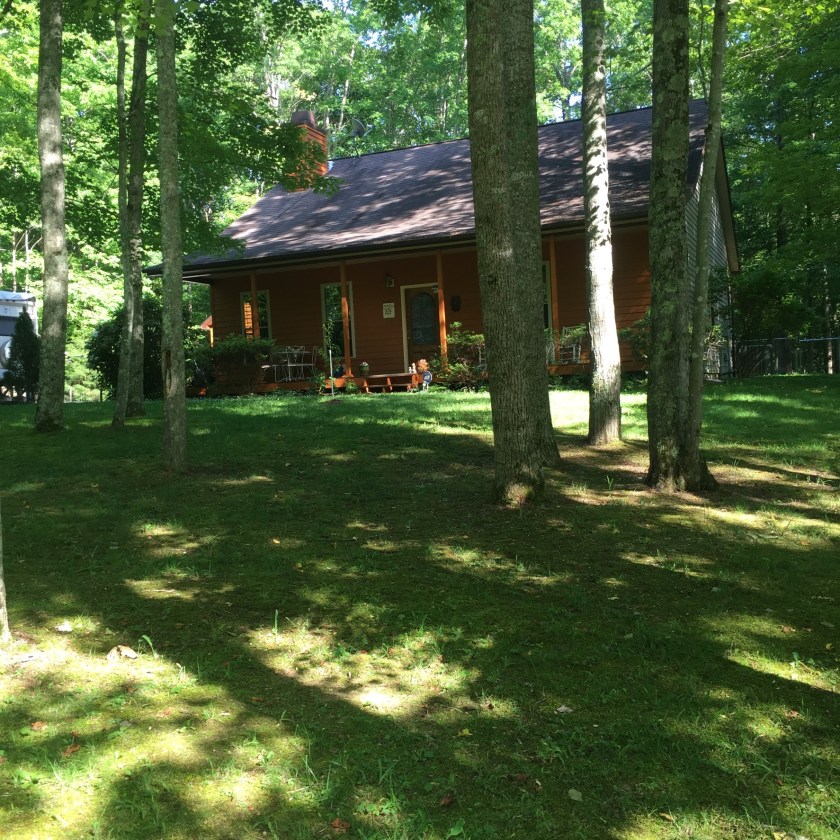
When I first moved to my home, 18 years ago now, I lived on a gravel, country road in a rural county in my state and my house was the only occupied house on the road. Life had been tough for me over the preceding few years and I needed to retreat, regroup, heal. I was also moving closer to my work after many long years of commuting. I loved it here. After being a city girl for 25 years, it was a restful sanctuary. My little cabin in the woods.

You see, I live right in the middle of the forest. Or I did. That part of the story comes later. There are still lots of very tall, probably second or third growth trees, mostly hardwood, around me. This area is known as “the hardwood capital of the world.” It is green, very green, dense, and beautiful. Most of all, it was private. I needed private. Most days, it seemed there was only me — and the wildlife. Beautiful birds. butterfly’s, one species which only lives on the particular mountain where I reside. Lots of whitetail deer.

My state is considered the number one state, at least by many hunting websites, in which to hunt whitetail deer. I’m not a hunter so that is mildly disturbing to me. I do understand, however, the need to reduce the herd from time to time. As far as the population of the whitetail deer is concerned, this state is always in the top ten.

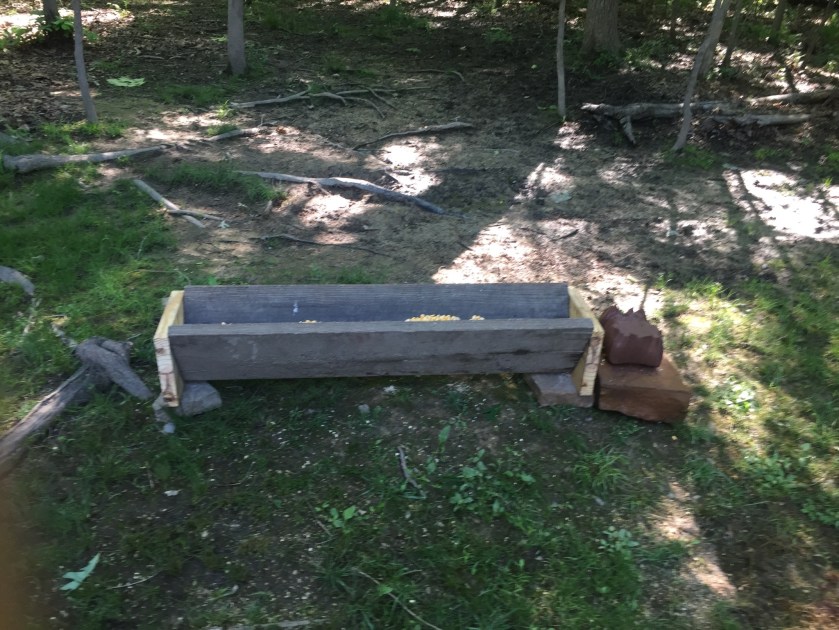
In the early days of my residence at my home, you could certainly tell that was true. I saw deer every day, a thrill for me. At first, they were skittish. I got the feeling they felt like I was encroaching, which, of course, I was. It is, after all, their land. So I bought some deer corn, cheap in those days, and put it out on the ground. They came to eat their corn and acted only mildly suspicious of me as I peered at them out the window. As time passed, I learned to tell the difference between the does and the bucks and learned that the little fawns showed up for their deer corn around June. The deer learned they were safe here and came every morning and evening. I made their deer feeding station a little more friendly for them. I added a real feeding trough, made by my cousin-in-law, and a salt block. I think the deer felt right at home. So did I. One of the highlights of my day was watching them.

That was then and this is now. I don’t have quite as many deer at the feeding trough as I used to. More houses have been built on the now-paved county road which means more people, more cars, but the deer still come. Until today. Today, I found out that the lot that adjoins my lot, right by their feeding trough, is going to be stripped of its trees and a house is going to be built 15 feet from my property line and right next to their food. When that happens, I will lose my deer. My friends for 18 years.

To me, this is a sign. It is time to move on if this happens. If that house is indeed built,  it may be time for this writer to find another sanctuary. The quiet will be gone. The deer will be gone. All the things I moved here for will be gone. It would be masochistic to stay.

So, I will wait a bit and determine if that offending house is going to be built. If so, I may start looking for yet another sanctuary. Writer’s need a retreat. The next one probably won’t be in the woods and there probably won’t be deer. But, I intend to find a special one.

Oh yes. The title of this post. “The Deer on the Porch.” One morning I was getting ready for work and I heard someone (I thought) clopping around on my front porch. I went to see who was at the door. It was a whole host of deer, walking around on my porch and one of them was peering in the glass!

They call the development of lots in a subdivision, even a rural one like mine, “progress.” Is it progress? It doesn’t feel like progress to me tonight. It feels like possibly having to leave home and leave my friends behind. It feels like I am at the mercy of a ruthless land developer who cares nothing about people or places or wildlife or life in general, but just money. It feels like that particular ruthless developer, when he chose the lot on which he was going to build, knew I would value my privacy enough to consider buying the lot from him rather than letting him build and he is price-gouging me. In coarser language, it’s called extortion.

This writer is a survivor and I have survived worse. This particular ruthless developer built my own house and I spent lots of money and time getting it fixed due to shoddy workmanship and the fact he didn’t pay all the subcontractors and walked off the job before it was completed. Not everything is fixed….even after 18 years. So, I have issues  with this particular ruthless developer. If he continues his planned project on the lot next door and without giving me adequate time to raise the cash I need to buy the lot or negotiating a reasonable offer, then I will have more issues with the ruthless developer. The house he will build will likely have workmanship as shoddy as my house did, before it was repaired. I wonder if anyone will buy it?

I am not going to be at the mercy of anyone, even a ruthless land developer. Just remember. There is always something you can do to help your circumstances. And I am going to do it. Progress? Perhaps I can keep my sanctuary here on the road in the woods and won’t have to look for another one. I hope my deer on the porch will remain on the porch. Stay tuned!

*Image copyright 2016 Rosemary Carlson

Posted in Appalachia, Eastern Kentucky, Food, Holidays, Memorial Day, Recipes, Uncategorized

Recipe for Memorial Day: Corn Pudding

image.jpeg

Just for fun, I want to share with you an old-fashioned Eastern Kentucky recipe that you might enjoy for your Decoration Day celebration. It came to me from my aunt, Sylvia Prater, who was born and raised in Appalachia. She was my mother’s sister, a wonderful cook, and our whole family enjoyed her big meals often as I was growing up and even after I became an adult. Here is her recipe:

Corn Pudding

Preheat your oven to 350 degrees.

Combine the following ingredients in a 13″ by 9″ baking dish:

2 cups frozen corn

4 beaten eggs (I recommend a cage-free brand)

2 cups milk  (I recommend skim milk)

2 tbsp butter (i recommend real butter like Kerry Gold)

1/4 cup sugar

Salt and pepper to taste

Grease your baking dish with a dab of the butter. Bake at 350 degrees for 45-60 minutes. Stir before it sets. Enjoy for your holiday dinner! #am writing #writing #blogging #appalachia #recipes

*Image courtesy of ji1991 https://freedigitalphotos.net


Posted in Appalachia, Eastern Kentucky, Holidays, Memorial Day, weekendcoffeeshare

#weekendcoffeeshare: 5/28/2016

image

Hello! I didn’t know if you would come by for coffee since it is Memorial Day Weekend, but I’m glad you did! It is such a beautiful day. Why don’t we sit out on the front porch at the table and we can have our morning beverages? Here….help me carry the pots. Thanks!

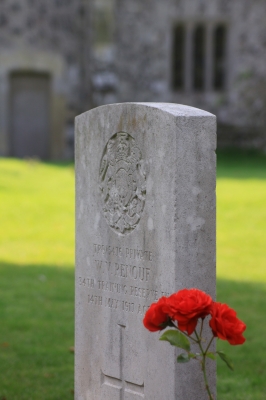
Tell me what you’re doing this holiday weekend? Oh, you are going to your family home in Floyd County! That county is right next to the county where my mother’s family came from. Are you taking flowers and going to a family cemetery? Yes, I know. My family cemetery is on top of a hill too. Also a private cemetery. So many of my ancestors are buried on top of one hill or another in Magoffin County in private cemeteries. The family all chips in every year to keep them maintained. So do you? That’s just the way in Eastern Kentucky, isn’t it? Very few of my relatives are buried in the public cemeteries in the area. Oh, you call Memorial Day Decoration Day, do you? So many people do in Appalachia. There is a whole story behind Decoration Day.

Memorial Day was originated as Decoration Day in 1868. It was established by the Grand Army of the Republic, the Union Veterans of the Civil War, to honor all the Civil War dead. An earlier Memorial Day, in 1866, was celebrated by women of the Confederacy in Columbus, Mississippi.

Memorial Day, or Decoration Day was celebrated on May 30 no matter what day of the week that date fell on. The families of the war dead usually celebrated the holiday by placing flowers on their graves. Gradually, Decoration Day included all war dead, not just Civil War dead. In 1971, Decoration Day, then called Memorial Day was designated a national holiday and was to be celebrated the last Monday of May.

In Appalachia and in most of the South, the tradition of the holiday did not change. It is still called Decoration Day and still celebrated on the Sunday before the last Monday of May. It’s an important holiday in Appalachia. Relatives of the war dead come home to the region from far-flung places to place flowers on the graves of their relatives and to see relatives still living in the area. It is a tradition that the cemeteries are cleaned and mowed, graves are cleaned up and weeds are cut, and everything is made to look nice for the holiday. All types of flowers are placed upon the graves from live to cut, artificial, and silk. Flags are placed on the graves of veterans. Usually, a big meal is eaten at some relative’s home and a lot of visiting takes place. In Eastern Kentucky, at least, relatives are buried in private cemeteries all around and through a county, or several counties. A lot of driving and walking up hills to private cemeteries is required.   You can’t even get a car up to where this writer’s grandparents and great-grandparents are buried.

Church services are often conducted in the local churches on Decoration Day. Some families celebrate it as a secular holiday. It seems that one of Americans’ favorite events on Memorial Day is attending one of the parades in thousands of cities and towns.

I’ve enjoyed having coffee with you today! I hope you enjoy Memorial Day!

*Image provided by Simon Howden #freedigitalphotos.net

**Thanks to parttimemonster.com for providing the linkup for #weekendcoffeeshare!